Evidence-based provider comparison
Best IB Tutoring Companies
Ownership and conflict disclosure
Hack Your Course researched and maintains this evidence-led comparison. Sources and material limitations are shown so readers can check the conclusions for themselves.
IB Tutors Canada is a Hack Your Course service, and Hack Your Course is included in this comparison. Hack Your Course can benefit if a reader chooses it. Providers cannot pay to improve their inclusion or placement, and every company—including Hack Your Course—is assessed using the same criteria and evidence standards. Because of our ownership, we do not describe this publication as independent.
Read the full methodology and corrections policy → (opens in a new tab)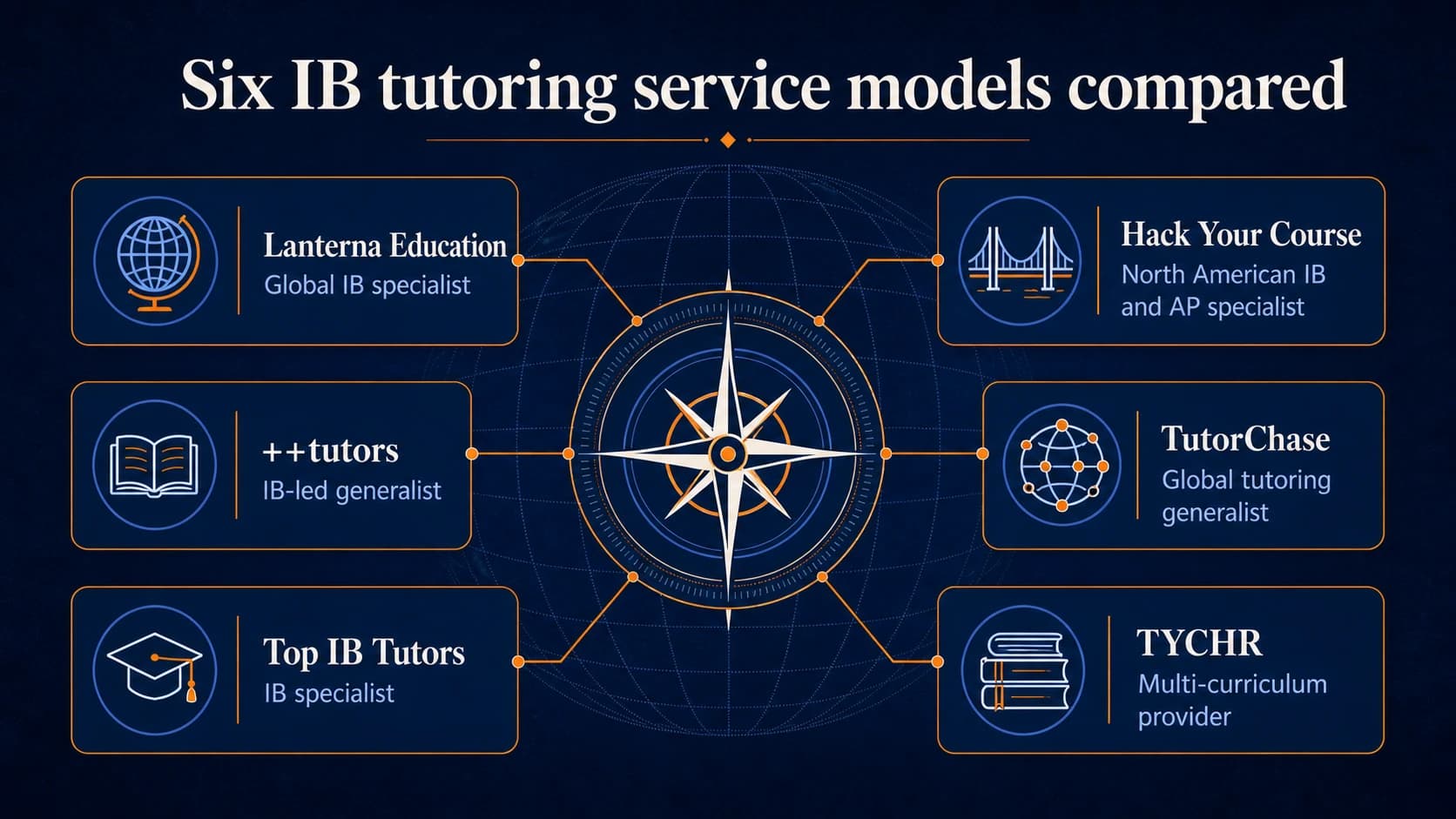
Jump to a section
- The short answer: which IB tutoring service is best?
- At-a-glance comparison
- Why a worldwide comparison needs different standards
- Research methodology
- Hack Your Course
- ++tutors
- Lanterna Education
- TutorChase
- Top IB Tutors
- TYCHR
- What the six providers reveal
- What does ten hours cost?
- Lowest-commitment purchase
- How to interpret review ratings
- Which service fits each student?
- Geography and time zone
- Academic integrity
- Safeguarding and student data
- Final recommendations
- Frequently asked questions
This comparison was researched using a consistent, evidence-based method. Every provider, including Hack Your Course, is evaluated using the same criteria, and no company is given a numeric score or an automatic top ranking. Any statements a company makes about itself, including those from Hack Your Course, are presented as provider claims rather than as independently verified facts.
To keep the comparison objective, this article uses the same evidence fields for every provider: corporate identity and public control, founder and leadership credentials, curriculum coverage, tutor model, matching and quality control, publicly visible pricing, payment commitment, cancellation and refund terms, geographic fit, academic-integrity safeguards, and independent review footprint. Claims made by a company about itself are identified as provider claims. Founder and owner credentials are treated as material evidence of academic governance and organizational judgment, though no credential, public price, or review score is considered enough on its own to prove the quality of every tutor or lesson.
This isn’t a universal ranking from first to sixth. Families have different constraints, and the strongest choice for an IB Mathematics: Analysis and Approaches HL student in Vancouver might be the wrong choice for a self-taught Language A student in Dubai or an MYP student in Singapore. The goal is to find the best fit for each need and to present the evidence supporting that conclusion.
Prices, policies, tutor rosters, and review counts can change. Confirm the final tutor, currency, taxes, cancellation window, package expiry, and refund language in writing before paying.
The short answer: which IB tutoring service is best?
There is no single best IB tutoring company that suits every student around the world. Based on the evidence reviewed through August 24, 2026, these are the clearest best-fit categories. For Canadian readers, North American providers are presented first, followed by profiles grouped by their main operating region. Placement is not an overall quality ranking.
Hack Your Course is North America’s first dedicated IB-focused tutoring service, now specializing in both IB and AP. It began operating in Vancouver in 2015 and offers managed matching, monthly pay-as-you-go billing and one flat regional rate regardless of tutor credentials. Most HYC tutors are career tutors—tutoring is their principal profession and livelihood. Its wider roster also includes certified teachers who tutor outside school hours, IB-trained or credentialed educators, IB examiners, university instructors, and experienced professional subject specialists. HYC hires no current undergraduate tutors; all tutors have completed at least a bachelor’s degree, and many—but not all—hold graduate degrees. These categories can overlap, and not every tutor holds every credential. The historical first-mover distinction receives no ranking weight, and families should still check the named tutor’s course, level and credential category.
++tutors is an IB-led international-curriculum generalist that now covers IB, AP, A-Level, and IGCSE, plus SAT, ACT, and MCAT test preparation. Its current site highlights certified IB teachers and examiners, recorded lessons, structured matching, and pricing in US dollars. It could appeal to families seeking teacher or examiner access within a broader curriculum platform, as long as they are fine with prepayment and a 48-hour cancellation policy.
Lanterna Education is a long-established global IB-focused network. It provides a wide tutor pool, school partnerships, three tutor categories, and substantial IB-specific infrastructure. Its package model is more transparent than many rivals, though families should still note prepayment terms, credit validity, tutor level, and cancellation policies.
TutorChase (also ibtutor.ca and ibtutor.us) is a broad global tutoring and education generalist spanning IB, AP, GCSE, IGCSE, A-Level, a long list of school-admissions and university-admissions tests (from 11+ and UKiset to UCAT, LNAT, STEP, IELTS, SAT, and ACT), and a separate revision platform. Its catalog keeps expanding, which makes it important to confirm the level of IB-specific depth. It provides broad subject coverage and a public IB price range, though families should check the individual tutor’s current IB experience and secure the tutoring contract before committing.
Top IB Tutors offers the clearest fixed hourly price ladder in this group and an explicit choice between high-scoring IB graduates and professional teachers or examiners. It seems a good option for families who want to make that trade-off consciously and pay after each session, though its independent review base and visible service terms remain rather limited. Note that it is not an independent IB-only firm: the site is the IB-branded storefront of Apex Tuition Australia, a general Australian tutoring agency, the same single-curriculum-domain strategy TutorChase uses with ibtutor.ca and ibtutor.us.
TYCHR is a broad India-based international-curriculum provider with a low-friction introductory-session entry point. It offers IB from PYP through DP, along with IGCSE, AP, A-Level, admissions tests, and university admissions. An August 20 homepage snapshot displayed Standard at $45, Premium at $65, and Elite at $95 per hour without identifying the dollar currency. That followed an August 6 check when no public rate was displayed and pricing followed a free demo. A separate platform page continued to describe personalized quotes, and the main site was not reliably accessible during the August 24 follow-up. Families should therefore confirm the applicable product, currency, package terms, refunds, and guarantee conditions in writing.
That summary is a starting point, not a verdict. The quality of the named tutor, the match with the student, and the commercial terms often matter more than the company logo.
At-a-glance comparison
This table is only a map. The detailed profiles and policy analysis below are the substance of the review.
| Provider | Market model | Hourly-price snapshot, normalized to USD where possible; provider-specific checks through August 24, 2026 | Payment model visible publicly | Most defensible best fit | Main point to verify |
|---|---|---|---|---|---|
| Hack Your Course | North America’s first dedicated IB-focused service; now IB/AP | US clients: $70 USD/hour online; Canadian clients: ≈$65 USD/hour (C$90/hour) online and ≈$87 USD/hour (C$120/hour) in person in Vancouver and Toronto; same rate across tutor credentials | Monthly pay as you go; no packages | North American families wanting managed matching, flat regional pricing and no undergraduate-tutor tier | Named tutor’s subject/level experience and which credential category applies |
| ++tutors | IB-led multi-curriculum generalist | $60-$150 USD/hour: Standard $60-$75; Premium $95-$150 | Prepaid sessions/packages | Families seeking certified IB teacher/examiner options in a broader platform | Final matched-tutor rate, expiry, recording policy, and 48-hour cancellation rule |
| Lanterna Education | Global IB specialist | ≈$79-$177 USD/hour, depending on tutor tier and prepaid package size | Prepaid packages of 3-180 hours | Families wanting an established, large IB-specific network | Tutor tier, package size, credit validity, and refund conditions |
| TutorChase | Global multi-curriculum and admissions generalist | ≈$41-$123 USD/hour (£30-£90/hour) | A cached July 9 terms copy described prepaid, auto-renewing packages; obtain current terms | Families wanting broad subject coverage plus a revision-resource ecosystem | Named tutor credentials, package renewal/refund rules, and resource subscription terms |
| Top IB Tutors | IB-only global online specialist | $50-$85 USD/hour: Academic $50 PYP/MYP and $60 DP; Professional $75 PYP/MYP and $85 DP | Pay after sessions; optional prepaid discounts | Families wanting explicit graduate-versus-professional choice and simple base rates | Detailed cancellation/refund terms and which package discount table applies |
| TYCHR | India-based multi-curriculum and admissions generalist | $45-$95/hour in an unspecified dollar currency in an August 20 homepage snapshot; not labeled USD | August 6: quote after free demo; August 20 homepage snapshot: three rates; separate platform page: personalized quote. Confirm the current model. | Families comparing several curricula or wanting to test the match first | Applicable product, currency, taxes, package terms, expiry, cancellation, refund, and guarantee mechanics |
USD conversion basis: Approximate USD figures in the comparison tables use the European Central Bank reference rates dated August 24, 2026: €1 = $1.1664 USD, €1 = £0.85550, and €1 = C$1.6154. These imply approximately £1 = $1.3634 USD and C$1 = $0.7221 USD. Converted figures are rounded to the nearest dollar, and the symbol ≈ marks a conversion. Original provider currencies are kept in detailed sections for audit purposes. These are comparison estimates, not transaction quotes; card rates, taxes, and fees may vary. TYCHR's August 20 snapshot used a dollar symbol without naming the dollar currency, so its $45-$95 range is not converted or labeled USD. (ECB euro reference rates)
Why a worldwide comparison needs different standards
The International Baccalaureate is genuinely global. The IB reported that, as of May 2026, more than 8,900 programmes were offered across more than 6,200 schools in over 160 countries, serving more than 1.95 million students across its four programmes. Those schools span the Americas, Africa, Europe and the Middle East, and Asia-Pacific. (IB facts and figures)
That global curriculum does not produce a uniform tutoring market. Five practical differences remain.
1. The syllabus is international, but the student's school context is local
An IB subject guide and final assessment framework may be shared across countries, yet schools make their own decisions about sequencing, internal deadlines, textbooks, mock exams, predicted grades, language support, and how the Diploma Programme fits with local graduation requirements. Even within North America, the overlap differs quite a bit. In the United States, taking AP courses alongside the IB is common and, in many schools, almost standard practice. In Canada, the situation changes by province: Ontario students balance IB courses with OSSD requirements, while in British Columbia, full IB Diploma students usually take the IB on its own, with only the provincial literacy and numeracy assessments running alongside. Canadian IB schools rarely, if ever, offer AP at the same time. A tutor who assumes one North American pattern applies everywhere will likely misread a student's real workload. Students in the United Kingdom or Europe may compare IB choices with A-Levels. Families in the Gulf or East Asia may focus on evening availability, bilingual support, or coordination with an international school's calendar.
A provider does not require a physical office in the student's city to teach effectively online. It does, however, need three things: a tutor who understands the student's specific subject, level, assessment schedule, and the school's expectations; an operating team that is available whenever a scheduling or safeguarding issue comes up; and academic oversight from someone who has actually taught the curriculum. This last factor distinguishes providers more than any office location does. In a company where an experienced educator oversees matching and advises tutors on a daily basis, a weak match is noticed and fixed. On a large platform where management is focused only on commercial aspects, no one above the tutor can really distinguish a strong lesson from one that is just delivered confidently.
2. “IB tutor” can describe very different qualifications
The title might describe a recent graduate who scored a 7, a postgraduate with subject expertise, a certified teacher, a current or former IB examiner, or someone with a mix of these backgrounds. No single option is always the best choice.
A recent school graduate with a high score often remembers what it's like to be a student, can show good study habits, and usually offers exam practice that feels relatable, often at a lower cost. Availability is usually the limit, since most are studying full time themselves.
A career tutor makes a living from tutoring rather than fitting it around another job. In practice that shows up in the work around the lesson: holding a regular slot through exam season, preparing between sessions, and following the instructions a school, coordinator, or parent has given. It does not, by itself, mean the tutor is a certified teacher, an examiner, or holds an IB credential.
An examiner often knows a lot about how assessments work and common mistakes students make. However, being an examiner doesn't always mean they are skilled at teaching or can guarantee a certain grade.
A subject specialist with an advanced degree can be very helpful if a student's challenges go beyond just exam techniques, especially if the specialist is familiar with the current IB course. Many career tutors are also subject specialists.
The right question is not simply, “Do you have examiners?” It is, “Who will teach this student, what is that person's current experience with this exact subject and level, and why is the match appropriate?”
3. Worldwide access introduces contract and currency risk
A family can arrange tutoring with a company located on another continent in just a few minutes. That ease of access means the agreement may be subject to another country's laws, use GBP or AUD for pricing, and contain package expiration or cancellation conditions that the family did not notice during the sales conversation. Fluctuations in exchange rates can also change the real cost.
This comparison, then, treats payment structure as an educational matter, not merely an administrative detail. A 30-hour prepaid package can help maintain continuity, but it also places more of the risk for matching and scheduling on the family. Pay-as-you-go rates may be higher per hour, but they offer flexibility and require the provider to retain the client by performing well.
4. Online tutoring can work, but the commercial brand is not the intervention
Randomized evidence indicates that well-structured online tutoring can boost learning. A 2024 randomized trial of an intensive online mathematics program for disadvantaged secondary students reported positive effects on both test scores and grades, and most tutors in that program were qualified mathematics teachers. (Journal of Public Economics study) Stanford researchers examining more than 16,000 virtual tutoring sessions also observed that one-to-one settings focused individualized instruction and relationship-building attention, though that study dealt with early literacy rather than IB students. (Stanford SCALE summary)
Those findings lend credibility to the idea of online tutoring. They do not validate the outcome claims of any commercial provider in this article. Program intensity, tutor preparation, attendance, curriculum, student group, and quality oversight all matter. Testimonials such as "moved from a 4 to a 7" are personal accounts, not causal proof.
5. IA, EE, TOK, and coursework support have an academic-integrity boundary
The IB requires that all work submitted for assessment be genuine and authentic. Its academic integrity policy clearly outlines the risks connected to private tutors and essay-writing or copy-editing services, stating that any work produced by a tutor must not be presented as the student’s own.
Advertising IA, EE, or TOK support is not by itself proof of misconduct. Ethical help might involve teaching research methods, clarifying criteria, asking guiding questions, helping a student organize their plan, or showing how to cite sources. It becomes misconduct when a tutor writes, rewrites, fabricates, or edits assessed work so much that it no longer reflects the student’s own ability. Each provider should be able to explain that boundary clearly.
Research methodology
Providers included
The six services were selected because they have visible IB-specific offerings, serve or market to online students beyond a single neighborhood, and represent distinct business models:
a long-established global IB specialist;
a North American IB/AP specialist that does not hire current undergraduate students as tutors;
an IB-led international-curriculum generalist;
a broad global tutoring, admissions, and resource platform;
an IB-branded storefront of a general Australian tutoring agency, with graduate and professional tiers; and
a broad multi-curriculum provider operating across many countries.
This is not a complete directory. Large general marketplaces and independent tutors were left out, since comparing thousands of self-selected profiles with those of managed IB services would require a different approach. Inclusion does not imply endorsement.
Evidence hierarchy
The research used the following order of preference:
Government company and trademark registers for incorporation, directors, registered control, legal entities, and brand ownership. A register entry applies only to the specific named entity and jurisdiction; it should not be taken as a statement about the entire international group.
Current official terms and pricing pages for the contracting party, rates, package validity, cancellation, refund, and service obligations.
Current official company, leadership, program, and tutor pages for operating history, named leaders, curriculum scope, tutor categories, matching, platform features, and provider-reported scale.
Universities and other institutional sources for degrees, research records, and independently documented founder history.
Independent review-platform pages for dated review counts, recent activity, and review-sourcing disclosures, not as proof of academic effectiveness.
Academic and IB primary sources for market context, tutoring research, and academic-integrity standards.
We excluded old pricing snippets, vague accusations, unsupported comments about employee pay, conclusions based only on a founder's education, and stereotypes related to culture or accent. The presence of a coworking space does not mean that the quality of teaching is low. Similarly, having ties to a prestigious university does not guarantee someone is an effective teacher. However, confirmed teacher training, experience with the IB, subject knowledge, and educational leadership are connected to the standards a founder or owner can establish. The country where a company is based does not determine the quality of its communication. The evaluation should link leadership evidence to governance and delivery evidence to the actual service a student experiences.
How ownership and leadership claims were handled
This comparison brings up questions that many tutoring comparisons tend to skip: Who started the service? Which company operates it? Who manages it now? What has the leader actually studied or taught? Public statements on these matters sometimes mix legal language or depend on old professional details, so every claim here was treated as a research lead and checked against current primary sources before being included.
Founder and owner credentials can influence the service a family receives. In a founder-led tutoring company, those in control might set tutor-entry standards, decide whether to hire certified teachers or recent graduates, appoint academic leads, approve safeguarding and academic-integrity rules, design complaint escalation, and determine how strongly commercial promises are made. Relevant teacher training, IB experience, subject expertise, and education management experience can strengthen that decision-making. A mainly commercial background can still support operations, but parents should then be able to identify the qualified academic leader who holds real authority over teaching quality. Opaque ownership or unverifiable biographies are therefore decision-relevant evidence gaps rather than minor omissions.
Current engagement matters as much as credentials. A founder's degrees show what they could once supervise, but their current role shows whether they still do. Families should ask if the founder stays active on the academic side, reviewing matches, guiding tutors, and maintaining standards, or if their focus has moved to fundraising, marketing, and product expansion. Rapid catalog growth is a visible warning sign: when a company adds new curricula and test-prep lines faster than it adds academic leadership, quality control often drifts from stated principles toward whatever sells. The practical test is straightforward: has leadership left clear written principles that hold up under delegation, and can the company identify who enforces them today? One check needs no insider access at all. Read independent reviews and see whether the founder’s name appears naturally. Parents do not mention an absent executive. A founder whose name appears repeatedly over years of customer reviews is clearly present in the service, while a leadership team that never shows up in any review is, at the very least, invisible to clients.
Four labels are deliberately kept separate throughout the article:
Founder means a person credibly identified as the creator of the service. It does not automatically mean current owner or chief executive.
Director or executive means a current legal or operating role. It does not by itself establish share ownership.
Person with significant control (PSC) is a UK registry category. A disclosed 50-75% band is reported as that band, not simplified to “sole owner.”
The brand owner or legal operator identifies the entity that holds a trademark, website, or customer contract. It may not reveal the ultimate shareholders of a wider group.
Leadership credentials are therefore assessed as a distinct and meaningful part of the comparison. A teaching degree and classroom record can prepare a founder to oversee pedagogy and notice weak instruction; a mathematics doctorate can show subject depth; an IB Diploma can offer direct program experience; and business training can help ensure steady operations. The relevance, however, depends on the leader's real authority and on whether the company has built systems that rely on that expertise. Because leadership credentials do not replace evidence about the assigned tutor, families should examine both governance evidence and named-tutor evidence.
Corporate identity and leadership snapshot
Hack Your Course
Brand and operating history: Hack Your Course began operating as a dedicated IB-focused service in 2015 and later expanded to AP. Its legal operator was incorporated in British Columbia on September 12, 2017, a separate corporate milestone. (British Columbia registry notice)
Publicly identifiable entity: Hack Your Course AP & IB Tutoring Service is operated by Advanced Teaching and Education Ltd., which also owns the registered HYC trademark. (Canadian trademark record)
Leadership and control: HYC identifies Masoud as the founder, and current customer reviews confirm his active management and oversight.
Credentials and governance: HYC indicates that Masoud is a certified teacher with a BEd, UBC master’s degrees in biochemical and environmental engineering, over 15 years of teaching and tutoring experience, and a current IB MYP/DP classroom teaching position at a school in Greater Vancouver, which remains unnamed to avoid any conflict of interest. This background is relevant to STEM governance, pedagogy, tutor selection, and intervention when a match proves weak, though the roster still needs independent verification.
++tutors
Brand and operating history: The provider says it was founded in Canada in August 2020.
Publicly identifiable entity: Current terms identify Plusplus Tutors Inc. as operator.
Leadership and control: The official site does not currently publish a founder, owner, CEO, or COO roster; third-party professional profiles naming Mohammad Kurwat were not treated as sufficient ownership proof.
Credentials and governance: The official site names four academic advisors and describes them as IB examiners. Academic advisors are not necessarily company owners or part of the executive team, especially since those tutors are tutoring at other companies.
Lanterna Education
Brand and operating history: Lanterna says the brand began in Stockholm in 2004 as an IB CAS project; its UK company was incorporated on 3 March 2009, making it one of the oldest companies in the market. The main office is located in Stockholm, Sweden, while a smaller one operates in Daventry, UK.
Publicly identifiable entity: Current terms name Lanterna Europe AB; the company page also lists UK and US entities.
Leadership and control: Hugo Wernhoff describes forming Lanterna with a partner. Daniel Bjarne, the current CEO, has a business background and keeps the company positioned as a top European provider. Wernhoff is the active person with significant control over the UK entity, holding a 50-75% share and a vote band. Kognity bought Lanterna and Elite IB in 2022, bringing both under a Swedish EdTech company.
Credentials and governance: Wernhoff's own IB background is relevant to the program focus; the CEO page does not publish formal academic credentials. Lanterna’s listed academic team adds further educational governance.
TutorChase
Brand and operating history: TutorChase is a UK-based EdTech platform that connects students around the world with tutors from top universities. Founded and incorporated in 2020; the company was originally named Admissions Tutors Ltd.
Publicly identifiable entity: TutorChase Ltd, UK company 12929942.
Leadership and control: Founder Rahil Sachak-Patwa is a director and the sole active person with significant control, holding a 50-75% share and vote band as well as director-appointment rights; Adrian Wynne is also a director.
Credentials and governance: Sachak-Patwa holds a DPhil in Mathematics from the University of Oxford, after studying mathematics at UCL and completing an Oxford master's in mathematical modelling, and the leadership team has considerable experience in high-level academics and private tutoring, including Mathematics and Science tutoring from age 16. That quantitative background matters for STEM screening and platform design. However, TutorChase still needs to clarify who brings similar academic authority for its non-STEM subjects and among its diverse tutor roster.
Top IB Tutors
Brand and operating history: Top IB Tutors, based in Melbourne, Australia, is an IB-branded site created in 2024 by people with IB tutoring experience, as a boutique storefront heavily focused on the Australian IB market, which is significant particularly in Victoria and NSW. It is a registered brand of Apex Tuition Australia, a well-established Australian tutoring agency operating since 2015. The parent company’s earlier date is distinct from the Top IB Tutors specialist brand’s 2024 creation.
Publicly identifiable entity: Apex Tuition Australia Pty Ltd owns and operates the brand.
Leadership and control: Max Milstein is publicly identified as Director and brand creator; current Apex shareholders are not established by the sources reviewed.
Credentials and governance: The provider bio reports a 44/45 IB score, a University of Melbourne BCom and Diploma of Languages, and about ten years of mathematics tutoring.
TYCHR
Brand and operating history: TYCHR says its service began in 2020. It is based in Gurugram, India, and is set up as a scalable tech-enabled service. (TYCHR timeline)
Publicly identifiable entity: TYCHR Private Limited, CIN U80903HR2021PTC097511.
Leadership and control: TYCHR identifies Arpit Bhardwaj as co-founder, Director, and CEO; registry-derived records also name Rashmi Bhardwaj as director. Share ownership details were not determined.
Credentials and governance: The leadership orientation is commercial and technology-focused rather than Western education administration. The provider reports a Business Administration degree but names no institution, and the same profile conflicts between "10+ years" and "over 20 years" of experience.
Criteria applied to every provider
Each profile addresses:
brand history, operating entity, public ownership or control, founder and owner credentials, their relevance to academic governance, and evidence gaps;
IB curriculum depth and breadth;
the tutor model and whether families can identify the individual tutor's credentials;
matching, replacement, progress reporting, and quality control;
worldwide availability and realistic time-zone fit;
public price and likely ten-hour cost;
pay-as-you-go versus prepayment;
cancellation, expiry, refund, and satisfaction language;
learning platform, recordings, and supplemental resources;
independent review footprint, including sample size and recency, on both customer platforms and employee platforms such as Glassdoor, because tutor working conditions can affect whether a family keeps the same tutor;
academic-integrity positioning; and
the students for whom the model is most and least suitable.
Why there is no numeric score
A single score would hide important value judgments. For example, should a lower-cost, graduate-led package be considered better than a higher-cost option with professional teachers? Is a 4.8 rating from 300 reviews actually preferable to a 4.9 rating that is split across several local Google profiles? How much should a flexible invoice offset a smaller tutor roster? No objective weighting can resolve these questions for every family.
Instead, the article presents evidence, highlights trade-offs, and gives best-fit recommendations. This method is less dramatic than a league table, but it is more useful for someone making an actual purchase.
The profile order below does not reflect any scoring or ranking. For Canadian readers, the two North American providers are listed first, with other profiles grouped by their main operating region. Hack Your Course's claim as a historical first mover does not affect the order.
Hack Your Course: North America’s first dedicated IB-focused tutoring service, now specializing in IB and AP
Best fit: North American families wanting managed matching, flat regional pricing and no undergraduate-tutor tier.
Less suitable when: The student is located outside North America and requires support outside HYC’s available scheduling window, or the family prefers an open marketplace where it can browse and contact tutors directly.
Meaning of the first-mover claim: “North America’s first dedicated IB-focused tutoring service” means a tutoring service founded in North America whose core service and brand were built specifically around the IB, rather than a general K–12 agency, marketplace, admissions consultancy, test-preparation company, or school that also offered IB subjects. A documented-provider search completed August 24, 2026 found no earlier North American service meeting that definition. This historical distinction receives no ranking weight. If you know of an earlier qualifying provider, send a dated primary source to info@hackyourcourse.com; we will review it and update the record if warranted.
Company history, ownership, and leadership
Brand origin: Hack Your Course began operating as a dedicated IB-focused service in 2015 and later expanded to AP. Its founder page identifies Masoud as the founder and says he established the service after more than 15 years of teaching and tutoring.
Legal operator and trademark: Hack Your Course AP & IB Tutoring Service is operated by Advanced Teaching and Education Ltd., incorporated in British Columbia on September 12, 2017. The same company is the registered owner of the HACK YOUR COURSE AP & IB TUTORING SERVICE mark. (Canadian trademark record; British Columbia registry notice)
Founder and current leader: HYC identifies Masoud as founder and says he remains actively engaged in all aspects of the company.
Public ownership evidence: The sources reviewed do not disclose the company’s current shareholders.
Provider-reported credentials: Masoud is described as an IB-certified teacher with a Bachelor of Education and two master's degrees from the University of British Columbia in biochemical and environmental engineering. (official founder profile)
Relative operating history: HYC began in North America in 2015. Lanterna began in Europe in 2004; ++tutors, TutorChase and TYCHR report 2020 operating starts, while the Top IB Tutors specialist brand was created in 2024. Apex Tuition Australia, its generalist parent, has operated since December 2015. These dates describe brand history and receive no automatic ranking weight. Masoud's profile is relevant to education in a way that a strictly commercial biography would not be. A BEd, teacher certification, further STEM study, and a long teaching background can help with curriculum choices, tutor selection, and spotting when a match is not working well. However, these do not by themselves confirm the admissions statistic, show that all tutors hold the same credentials, or guarantee that every management choice is sound from a teaching perspective. HYC reports that most tutors are career tutors who earn their living primarily through tutoring. Its roster also includes certified teachers who tutor outside school hours, IB-trained or credentialed educators, IB examiners, university instructors, and experienced professional subject specialists. It hires no current undergraduate tutors; all tutors have completed at least a bachelor’s degree, and many—but not all—hold graduate degrees. These categories can overlap, and not every tutor holds every credential. This article therefore evaluates Masoud's qualifications as leadership evidence and evaluates the actual roster separately as delivery evidence.
Service model and curriculum focus
Hack Your Course is the narrowest regional provider in the comparison. It focuses on IB and AP and positions its online service around the United States and Canada, with named operations in Seattle, Vancouver, and Toronto. That is specialization in two advanced secondary-school systems, not an IB-only specialization or worldwide generalism. All of their tutors are from North America. (Hack Your Course homepage; Why Hack Your Course)
The regional focus becomes significant when an IB student is also working toward a Canadian provincial diploma, a US high school curriculum, AP courses, or North American university requirements. This does not imply that a North American tutor is automatically better suited for the IB. Rather, it suggests that the provider is better positioned to understand the broader academic context, so the parent does not need to clarify it from the outset.
The company should not be described as a worldwide service on the present evidence. Its site specifically addresses US and Canadian families. A family in another country may inquire about tutor availability, but details such as international enrolment, currencies, support hours, and contract handling should be verified instead of simply assumed.
Tutor model, matching, and oversight
Most HYC tutors are career tutors: tutoring is their principal profession and livelihood. Its roster also includes provincially and state-certified teachers who tutor outside school hours, educators with formal IB training or IB educator credentials, IB examiners, university instructors, and experienced professional subject specialists. HYC does not hire current undergraduate students as tutors; all tutors have completed at least a bachelor’s degree, and many—but not all—hold graduate degrees. These categories can overlap, and not every tutor holds every credential. It states that matching takes into account not only the subject and level but also learning style and personality. Management reviews tutor session reports and maintains the relationship after the introduction, rather than treating the service as an open-profile marketplace. (Why Hack Your Course)
That ongoing oversight is one of the company's more defensible differentiators. A managed service can spot missed sessions, an ineffective explanation style, or a disconnect between school content and the tutoring plan earlier than a family would when buying services from an unaffiliated individual. The value, however, still depends on the quality of tutors' reports, which must be entered after every session.
Hack Your Course reports that most of its tutors are career tutors and that some tutors work with the company long term. It does not currently publish a defined tutor-retention percentage, cohort, measurement period, or calculation method. Career tutoring is not universal across the roster: certified teachers may tutor outside school hours, while university instructors, IB examiners, and other specialists may hold parallel professional roles. A majority-career-tutor model can make continuity easier, but families should confirm whether the proposed tutor can remain with the student through the intended period. The company confirmed another operational detail for this review that makes the international-scheduling claim more specific: since North American students book after-school and evening hours, its career-tutor cohort has weekday mornings relatively open. A North American morning aligns with the afternoon or evening in Europe and the Middle East, and with late evening in some parts of Asia, so international students can be scheduled into these open morning slots instead of competing with domestic demand. The tutors themselves remain based in North American time zones. A limited tutor-side continuity signal exists: Glassdoor reviews of the company include current and former tutors reporting tenures ranging from 3 to more than 5 years, with a 4.9/5 rating in a small sample and a 100% would-recommend figure. Anonymous employer reviews are self-selected, and this article gives them no weight on pay or policy details, but stated tenures are among the few public tutor-perspective signals available for any provider in this comparison. They do not establish a company-wide retention rate.
Families should ask for the proposed tutor's biography before the first paid lesson and check four details: recent experience with the specific IB course; HL or SL experience, if applicable; background in classroom or one-to-one teaching; and any examiner role mentioned by the sales team. "Our roster includes examiners" does not mean "your assigned tutor is an examiner."
Pricing, commitment, and guarantee
Hack Your Course has one flat hourly tutoring rate, with billing determined by the client's location rather than the tutor's credentials:
| Client location | Provider-billed rate | USD-normalized hourly rate | Ten-hour USD illustration |
|---|---|---|---|
| United States | $70 USD/hour online | $70 USD/hour online | $700 USD online |
| Canada | C$90/hour online; C$120/hour in person | ≈$65 USD/hour online; ≈$87 USD/hour in person | ≈$650 USD online; ≈$866 USD in person |
Hack Your Course publishes these regional rates. All tutors are billed at the same regional rate; assignment to an IB examiner, certified teacher or another professional tutor does not create a separate surcharge.
The standard public model offers monthly pay-as-you-go billing for sessions used, without requiring a large upfront payment. Hack Your Course does not offer prepaid or longer-term tutoring packages. Its published cancellation policy says a session may be cancelled or rescheduled without charge with at least 24 hours’ notice; with less notice, the full session fee applies. Families should still confirm tax treatment, session duration and whether services outside regular tutoring are billed differently.
The published First Session Satisfaction Guarantee applies to long-term tutoring engagements when HYC selects the tutor. If the family is not satisfied after the first session, that session is not charged.
Review evidence
Trustindex displayed a 4.9/5 rating from 217 reviews—215 Google and 2 Facebook—including 208 five-star reviews, checked August 24, 2026. The total combines multiple source listings rather than representing one Google Business Profile. Trustpilot lists only two reviews, too small a sample for a meaningful provider comparison.
The responsible interpretation is that HYC has a substantial aggregator-visible review footprint. These self-selected customer reviews are useful evidence of customer experience, not an independently normalized worldwide rating or proof of academic outcomes.
Strengths
focused rigorous IB/AP positioning rather than dozens of unrelated tutoring categories;
an educator-led, managed model with session reporting and intervention after matching;
a provider-reported majority-career-tutor model, which can support continuity across the two-year Diploma, although no defined retention percentage is published;
a simple flat rate by client geography, normalized here to USD;
monthly pay-as-you-go billing, eliminating unused-package risk;
local familiarity for many US and Canadian families; and
a first-session fit mechanism, subject to the final agreement.
Trade-offs and unanswered questions
because HYC says it accepts fewer than 2% of applicants and does not hire current undergraduate students, families seeking a rare subject or a peak-season match should confirm current availability;
families should confirm the named tutor’s subject and level experience and which credential category applies; and
families outside North America should confirm that the proposed schedule and support hours fit their time zone.
Bottom line on Hack Your Course
Hack Your Course is best understood as a North American managed specialist, not as an automatic worldwide winner. HYC reports that its founder is a certified teacher with a BEd, UBC master's degrees in biochemical and environmental engineering, and more than 15 years of teaching and tutoring experience, an unusually relevant leadership profile for supervising STEM pedagogy, tutor selection, and ongoing match oversight. Its provider-reported majority-career-tutor model, one-rate-per-region pricing, and low-commitment billing are also meaningful advantages for the right family. Families should verify the named tutor’s subject/level experience and which credential category applies, using the same care applied to every competitor.
++tutors: an IB-led generalist with teacher and examiner options
Best fit: Families who want managed global matching, recorded online lessons, prices in US dollars, and the ability to find support across IB, AP, A-Level, IGCSE, or SAT/ACT/MCAT test preparation within one provider.
Less suitable when: The family does not want to prepay, needs a cancellation window shorter than 48 hours, objects to recorded sessions, or wants an unconditional refund of unused one-to-one credits. Prepaid credits also increase the risk for the family when a student is already having difficulties. A replacement tutor from the same roster is usually available, which can address a tutor-fit issue; however, it does not address an overall direction issue. If the first sessions show that the student actually needs a different type of support, a different subject focus, a specialist not on the roster, or even a break, non-refundable credits cannot be transferred with the student, so the solution is limited to what the provider can offer.
Company history, ownership, and academic leadership
Brand origin: ++tutors says it was founded in Canada in August 2020.
Legal operator: The current terms identify Plusplus Tutors Inc. as the company operating the website and place the agreement under Ontario and applicable Canadian law.
Founder and ownership evidence: The official site does not currently publish a list of founders, owners, CEOs, COOs, directors, or shareholders.
Corporate-leadership lead: Third-party professional directories and an older self-description identify Mohammad Kurwat (with a sales and business education and background) as co-founder and COO, but the accessible official sources reviewed do not verify that current title or any equity ownership.
Academic leadership:The official About page names four academic advisors, Jon Paradis, Birute Richardson, David Cook, and Ali Yuksel, and describes each as an IB examiner in a defined subject area. The page does not mention the scope, time commitment or exclusivity of these advisory roles. Their senior IB examiners often collaborate with multiple tutoring organizations at the same time, so simply having the advisor title does not clarify how involved any of these individuals is in the company's operations or quality control.
The absence of a public founder page does not indicate that the company lacks leadership, and there is no substantial doubt about the co-founder's identity: professional directories and the company's earlier self-descriptions consistently identify Mohammad Kurwat, whose background is in business rather than education, as co-founder and COO. What a reviewer cannot responsibly determine from the current website or any accessible registry is the separate issue of who currently owns and controls ++tutors, since founding a company and retaining its shares years later are not the same thing. Plusplus Tutors Inc. is listed as the legal operator in the contract, yet this review did not confirm incorporation, directors, or beneficial ownership from any accessible primary registry record. Families making a significant prepayment can reasonably ask for the company's jurisdiction and registration number, the name of the executive in charge, and the escalation contact above the student-advising team. (++tutors About page; ++tutors terms)
Why ++tutors is a generalist, and why that is not an insult
++tutors started with a strong IB identity and continues to provide the IB with its most detailed public coverage. Its current range of services also includes dedicated AP, A-Level, IGCSE, PYP, MYP, and DP options, and its program selector now features SAT, ACT, and MCAT test preparation. The accurate description is therefore IB-led international-curriculum generalist. (++tutors homepage; tutor directory)
Generalism can be useful. For example, a family might have one child enrolled in IGCSE and another in the DP, or perhaps an IB student preparing for an AP examination. Having a single provider can make billing and coordination easier. However, this means the family needs to check the specific tutor's expertise in the relevant course rather than relying on the company's broad reputation.
Tutor model, matching, and lesson platform
The provider states that its IB network features certified teachers, current or former IB examiners, department heads, and other experienced curriculum specialists. Its homepage makes the categorical claim that every tutor is an IB teacher, examiner, or both, while other pages on the company’s website indicate that about 60% have held or currently hold an official IB role and mention a wider group of specialists. The defensible statement is that the network includes many teachers and examiners; it should not be described as uniformly examiner-led. Moreover, it does not exclude university students or recent high school graduates who were IB students. (++tutors homepage; about ++tutors)
Matching is organized through a curated process instead of an open marketplace. The package page notes that the team assesses the student's needs and then provides two or three possible choices. Tutor profiles display their subjects, experience, credentials, and time zones. Lessons take place in the Lessonspace classroom, and the company states that sessions are recorded for both quality monitoring and student review. (++tutors packages)
Recording can help with review and quality control, though it does involve student data. The terms also include a photo and video marketing release unless families opt out by email within the specified deadline. Parents should inquire about who can access the recordings, where they are stored, how long they are retained, whether they are used for educational materials, marketing, staff training, or AI features and training, and how to refuse or withdraw consent.
Pricing and ten-hour cost
The tutor page lists Standard educators at $60-$75 USD per hour and Premium specialists at $95-$150 USD per hour. Published IB packages begin at:
5 sessions from $325 USD, or an effective $65 USD per hour;
12 sessions from $720 USD, or $60 USD per hour;
19 sessions from $1,080 USD, or about $57 USD per hour; and
39 sessions from $2,160 USD, or about $55 USD per hour.
These effective figures are calculated by dividing the advertised starting package price by the number of included sessions. They refer to the starting Standard rate, which may not match the rate of the tutor a family chooses. Premium specialists are still significantly more expensive. Packages under $1,000 are prepaid, while the site lists payment plans for larger purchases. Credits usually remain valid for 12 months, although a longer validity period is mentioned for the largest plan. (++tutors packages)
For a simple ten-hour comparison, the published Standard range implies $600-$750 USD and the Premium range $950-$1,500 USD before any package-specific quotation. Families should not assume the lower package average applies to an examiner or a high-demand subject.
Cancellation, refund, expiry, and public inconsistencies
The legal terms and FAQ state that at least 48 hours' notice is required to cancel or reschedule a lesson; otherwise the fee will be forfeited. Clients who do not attend a scheduled session are charged the full amount. The terms specify that one-to-one tutoring credits are non-refundable and that all sales are final, except for the first-session satisfaction policy. Any request for a refund or replacement after the initial session must be made within 24 hours. If the client does not reply to contact attempts from the company or tutor for two months, their credits may be rendered invalid. (++tutors terms of use; money-back guarantee)
Review evidence
On July 13, 2026, Trustpilot showed a rating of 4.2 out of 5 based on 22 reviews. The sample size is limited, and many of the positive comments come from people who say they are tutors or contractors, not from families who purchased services. The page features favorable feedback about specific tutors and support, along with a few significant complaints; these complaints are claims, not established facts.
A separate observation, added during an August 3, 2026 recheck: ++tutors' individual pages show provider-hosted review counts that do not match. A homepage badge shows 4.9 from 242 reviews; the company's reviews page reports 4.7 from 423 reviews collected through its own post-session feedback system; and a Google badge on the same homepage shows 4.9 from 62 Google reviews. The self-hosted testimonials seem authentic and mention specific tutors, but they are collected and verified by the provider itself, not by an external platform, so this comparison uses only platform-verifiable numbers. On that same recheck, those independent numbers were modest: the company's Google Business Profile showed 4.9 from 62 reviews, and Trustpilot showed 17, down from 22 on the July 13 research date, indicating that several reviews have been removed from that platform. The total independently hosted footprint is about 79 reviews. That is a valid and growing record for a company established in 2020, but it represents only a portion of the numbers shown on the provider's own pages, and any family referencing the larger totals should ask which collection system they came from.
The appropriate conclusion is that ++tutors has some independent review visibility but not enough family-review volume to carry the decision. The first-session remedy, contract terms, and proposed tutor should receive more weight.
Strengths
a substantial IB practice inside a broader international-curriculum service;
curated matching and visible tutor profiles;
published Standard and Premium price ranges;
recorded interactive lessons and post-session feedback; and
free tutor switching plus a time-limited first-session guarantee.
Trade-offs and unanswered questions
prepayment and non-refundable-credit language;
a stricter 48-hour cancellation rule than several competitors;
credit-expiry and client-response provisions;
conflicting public statements about tutor composition and unused credits; and
a small, mixed independent review sample; and
no current official page identifying corporate founders, owners, or accountable executives.
Bottom line on ++tutors
++tutors belongs in a worldwide comparison as a serious IB-led generalist, not as a caricature of a student marketplace. Its most prominent public features include curated matching, named examiner-advisors, options for teacher or examiner tutors, a range of prices, and a recorded lesson platform. The main risks for consumers are commercial and governance-related: prepaid credits, a 48-hour cancellation window, notable differences between marketing summaries and legal terms, and the absence of an official corporate leadership page at present.
Lanterna Education: the most established global IB specialist in this comparison
Best fit: Internationally mobile families, students who need less common IB subjects, schools or families seeking a large IB-focused ecosystem, and those who appreciate being able to choose between graduate, teacher, and senior-specialist tutors.
Less suitable when: The family does not like prepayment, may not use all their hours before they expire, prefers a straightforward unconditional refund after two lessons, or is price-sensitive. Lanterna advertises packages rather than a single pay-as-you-go rate; the normalized comparison range is approximately $79-$177 USD per hour depending on tutor tier and package size.
Company history, ownership, and leadership
Brand origin: Lanterna says it started in Stockholm in 2004 as an IB student CAS project.
Current contracting and regional entities: Its current terms name Lanterna Europe AB in Sweden. Its company-details page also lists Lanterna Education Limited in the UK and Lanterna Education Inc. in the United States. The main office is in Stockholm, with a smaller office in Daventry, UK.
Founder evidence: Hugo Wernhoff has written that he and a partner formed Lanterna after their own IB experience. The available history supports describing Wernhoff as a co-founder, not as the only founder.
Current leadership: Lanterna's official careers site lists Daniel Bjarne, who has a business background, as CEO. UK filings list Bjarne and Emily Petersen (with a finance background) as current directors of Lanterna Education Limited.
Public control evidence: Companies House lists Wernhoff as the sole active person with significant control of the UK company, holding more than 50% but less than 75% of its shares and voting rights, and the right to appoint or remove directors.
The dates here tell two related but distinct stories. 2004 is the year the provider says it began operating, while March 3, 2009 is when the UK entity was incorporated. The current website also lists a Swedish and a US entity. A family should check which entity will be named on its invoice and contract, since the UK PSC record does not clarify who ultimately owns every Lanterna company. (Lanterna history; company details; UK company overview; UK control record)
The corporate history also shows a broader edtech relationship. Kognity bought Lanterna and Elite IB in 2022, bringing them together under a Swedish EdTech company. The available record does not show the entire current group cap table. Elite IB founder Tim Hoffmann joined the leadership team at the time. (2022 Elite IB announcement; Kognity 2022 review)
Service model and worldwide reach
Lanterna is an IB specialist with a global reach, working with both individual families and schools. Unlike general tutoring companies that simply offer IB as one of their services, Lanterna’s current structure centers on IB tutoring, courses, school staffing, and programme support. The company states it has over 20 years of experience, partnerships with more than 250 schools, support for over 20,000 students, and a team of more than 600 vetted teachers and tutors. These figures are reported by the company itself and are not independently audited.
Its school-services division is important for consumer comparison, as it demonstrates experience working with institutions, not just individual matching. This includes substitute teachers, full-year online teachers, and help with subjects that schools sometimes struggle to staff. It also means Lanterna has a wide international tutor network. Families should still check that the suggested tutor is available in their time zone; "worldwide" refers to the network's reach, not a promise that every subject is covered at every local hour. (Lanterna for schools)
Caution is warranted when considering school-partnership claims in this market. When schools work with a provider, they are usually buying staffing services, such as substitute teachers or full-year teachers for subjects that are difficult to staff, rather than supporting the provider’s consumer tutoring for families. Official endorsements of private tutoring companies by schools are still uncommon, partly because of conflict-of-interest and equity concerns. Case studies that mention specific schools and testimonials from coordinators reflect a staffing arrangement; they should not be interpreted as the school recommending any company’s one-to-one tutoring service to parents unless an authorized senior representative of that specific school has independently endorsed the quality of the company’s tutoring through a legitimate review.
Tutor tiers and curriculum coverage
Lanterna separates its tutor pool into three categories.
Graduates who, according to the provider, scored 40 or more IB points and a 7 in the subjects they teach. Graduate here means high school graduates, not necessarily university graduates.
Teachers with classroom and IB curriculum experience; and
Specialists, including senior teachers, examiners, or markers for higher-complexity needs.
This gives more information than simply calling every tutor an "expert," since it helps a family pick a model. A well-organized graduate can work well for structured practice or mentoring, while a teacher might be a better fit for rebuilding understanding. A senior specialist could be the right choice for an unusual course or a complex assessment question. The tier label does not take the place of the named tutor's biography.
Lanterna advertises coverage across the six DP subject groups, Math AA and AI, TOK, the Extended Essay, Internal Assessments, exam preparation, and a range of less commonly offered subjects. Its matching process takes into account subject, goals, personality, and time zone. (Lanterna pricing and tutor types; how it works)
Pricing and package structure
Lanterna publishes three tutor tiers and package sizes ranging from 3 to 180 hours. On August 24, 2026, its pricing page advertised packages starting at £58 per hour. Across that advertised starting point and the highest captured Specialist package rate, the USD-normalized comparison range is approximately $79-$177 USD per hour, depending on tutor tier and package size. With EUR selected, the live pricing cards had shown the following minimum package totals on July 13, 2026. They are retained in the original currency as an auditable dated snapshot; each card used “From” because Standard, Multi, and Flex cover hour ranges. (Lanterna pricing)
| Tutor tier | Standard minimum | Multi minimum | Flex minimum |
|---|---|---|---|
| Graduate | €295 for 3 hours (€98.33/hour) | €2,280 for 30 hours (€76/hour) | €6,000 for 90 hours (€66.67/hour) |
| Teacher | €635 for 5 hours (€127/hour) | €3,140 for 30 hours (€104.67/hour) | €8,280 for 90 hours (€92/hour) |
| Specialist | €760 for 5 hours (€152/hour) | €3,795 for 30 hours (€126.50/hour) | €10,250 for 90 hours (€113.89/hour) |
The euro package totals and hourly calculations above document the July 13 selector state. The approximately $79-$177 USD comparison range uses the August 24 normalization described above and is a directional range, not a promise that every tier can be bought at either endpoint. Prices can change with the selected currency, tutor tier, and number of hours, so families should keep a record of the exact configuration used for their purchase.
The current structure distinguishes the following package families. (Lanterna packages)
shorter Standard packages for one subject, generally 3-15 hours with credits lasting 3-6 months;
Multi packages for up to two subjects, generally 30-80 hours with credits lasting about 10 months; and
Premium Flex packages covering unlimited subjects, generally 90-180 hours with credits lasting 18-24 months.
Those larger packages might work well for a family planning support throughout the Diploma Programme. However, they may not be ideal for a student who only needs help with one urgent unit or is unsure about tutor compatibility. The expiry date should be considered part of the price, since an unused prepaid hour still has its full cost even though it provides no instruction. The price is also higher than that of all other companies.
Lanterna's terms state that packages are prepaid and are usually non-refundable, except where withdrawal rights apply or as outlined in their satisfaction process. For individual lessons, at least 24 hours' notice is needed to cancel; if you cancel late or do not show up, the booked hour will be used. Consumers have a 14-day right to withdraw, but Lanterna can deduct a proportional fee for any services already provided. (Lanterna terms of service)
The satisfaction guarantee is narrower than the headline
Lanterna's pricing page states that students can get a refund if they are not satisfied after the first two hours. However, the legal terms include some extra conditions. The guarantee is valid only for packages of at least ten tutoring hours. Students must raise a complaint after they have completed at least two hours but no more than five. Lanterna will then assign a replacement tutor. A full refund is only available if the student remains unhappy after spending an additional 2 to 5 hours with the new tutor. Group courses do not qualify for this guarantee.
That is still a substantive remedy, but it is a rematch-then-refund process, not an immediate unconditional two-hour refund. The contract language should govern the purchase decision.
Quality control, outcome claims, and assessed work
Lanterna states that it uses feedback within its portal and holds regular check-ins to track how well the match is working. Its terms guarantee reasonable skill and care, but they clearly do not promise any specific academic outcome. The terms also mention that, when support involves official assignments like an IA or EE, the student must make sure that their school allows this kind of help. This is a helpful warning, but families should also consider what Lanterna itself forbids its tutors from doing.
Review evidence
On the research date, Trustpilot listed Lanterna with a 4.8/5 rating from 320 reviews, including 66 posted in the previous 12 months. The profile indicated that Lanterna has a paid Trustpilot subscription. Most recent reviews were positive about tutor matching, preparation, and responsiveness, though a smaller group mentioned concerns about cost or policies.
A rating does not show the student's starting point, how much tutoring they received, the difficulty of the subject, or what might have happened otherwise.
Strengths
long-established IB-specific service and school-facing infrastructure;
large, international tutor network with strong subject breadth;
transparent separation of graduate, teacher, and specialist models;
public prices for every tutor tier and package family, plus package-validity information; and
substantial recent third-party review activity compared with most specialists here.
Trade-offs and unanswered questions
prepaid packages transfer unused-hour and matching risk to the family;
the total prepaid commitment rises sharply from Standard to Multi and Flex;
credits expire on different schedules;
the satisfaction headline is simpler than the legal process; and
the contracting entity, group-wide ownership, governing law, taxes, and consumer rights deserve attention in a cross-border purchase.
Premium pricing
Bottom line on Lanterna
Lanterna has substantial evidence of being a mature, worldwide IB-specialist ecosystem in this group. Its roots in an IB graduate's CAS project, later work on curriculum and technology, scale, tutor types, named academic infrastructure, school services, and subject variety together support a governance model shaped by IB experience. Its public pricing is more detailed than most: the chosen tier, package size, expiry period, and conditional guarantee all affect the actual value. Its UK control record is more transparent than usual, though it should not be seen as a full picture of the international group's ownership.
TutorChase: a broad global tutoring and admissions generalist
Best fit: Families that want wide subject availability, support spanning more than one international curriculum, and an ecosystem that combines one-to-one tutoring with IB revision resources and admissions services Less suitable when: The family prefers a true pay-as-you-go model, would decline any package with automatic renewal, or is not ready to commit before verifying the assigned tutor’s specific IB credentials and current contract on their own. For a student who is already behind, prepaid auto-renewing packages can place the burden of a slow start on the family, so more closely supervised remediation is safer with a lower-commitment arrangement. There is a similar limitation for families who want tutoring that is actively managed rather than just a strong initial match. TutorChase’s public information mentions consultant-led matching, platform tools, and resources, but does not describe a clear oversight process after the match, such as staff-reviewed session reports or regular progress check-ins. The model is designed for matching at scale, not for continued supervision. If a family wants someone above the tutor to oversee the plan, they should ask, before making payment, who will monitor the engagement and quality after the introduction and in what way.
Company history, ownership, and leadership
Founder and origin: Oxford's St Anne's College records that Rahil Sachak-Patwa founded TutorChase in 2020. (St Anne's College Record)
Legal entity: TutorChase Ltd, a UK company (12929942), was incorporated on October 5, 2020, under the name Admissions Tutors Ltd and later adopted the name TutorChase.
Current directors: Companies House lists Sachak-Patwa and Adrian Wynneas as active directors.
Public control evidence: Sachak-Patwa is the sole active person with significant control, holding more than 50% but less than 75% of the shares and voting rights, and the right to appoint or remove directors. (control record)
Founder credentials: Institutional records document mathematics at University College London, an Oxford master's in Mathematical Modeling and Scientific Computing, and an Oxford DPhil in industrially focused mathematical modeling.
TutorChase offers the most transparent public record of founder control among those compared. The registry confirms majority control, but "sole active PSC" does not necessarily mean "sole owner." The percentage range allows for additional shareholders, and the St Anne's account notes that alumnus Steve Huxter became an investor after initially mentoring Sachak-Patwa in an Oxford Foundry entrepreneurship competition. The precise cap table and Huxter's current stake are not disclosed in the sources reviewed. (TutorChase company overview; directors; control record; St Anne's College Record, pp. 33-35)
The educational implication is somewhat complex. A founder with a mathematical background with years of tutoring experience could be well-suited to evaluate quantitative expertise and develop corresponding systems. TutorChase now covers languages, humanities, admissions, and multiple curricula, so subject oversight cannot depend solely on one founder's STEM qualifications. Families should inquire which academic leader is responsible for each subject and how the standards for professional teachers and graduate tutors differ.
Service model and curriculum breadth
TutorChase stands out as the most obvious generalist in this comparison. Its main navigation now includes GCSE, IGCSE, A-Level, IB, and AP, as well as school-admissions tests (11+, ISEB Pre-Test, Common Entrance, UKiset, CAT4), university-admissions support (UK, Oxbridge, and US college admissions, UCAT, LNAT, ESAT, TMUA, TARA, STEP, IELTS, SAT, ACT), and a separate revision platform. The catalog has continued to grow, and its broad scope raises a reasonable resourcing concern: as a single team manages more product lines, it becomes more difficult to maintain the same level of academic depth, up-to-date syllabus materials, and quality control across all areas. Inside that wide platform, the IB offering is significant rather than just an add-on. The IB page lists IBDP and MYP tutoring, HL and SL coverage, all major subject groups, TOK, the Extended Essay, and global online delivery.
That broad scope can actually address real family issues. A student could need help from an IB Physics tutor right now, and then require university admissions support at a later stage. Siblings might be enrolled in different educational programs. The provider might be able to cover an uncommon subject by drawing on a wider international network. However, this approach carries a risk of brand-level confusion: a platform may have strong IB expertise overall, yet the specific tutor assigned might have only limited experience with the student’s current teacher or chosen topic.
Tutor mix and match
TutorChase's network is a mix of different backgrounds. Published profiles include qualified teachers and examiners, experienced professional subject tutors, university alumni, and current university students. The service states that a consultant matches based on the student's goals, schedule, time zone, and budget, then shares the recommended tutor's qualifications and experience for approval. (TutorChase tutor profiles; tutor applications) This is an important correction to two overly simple descriptions. TutorChase should not be presented as just a peer-tutor marketplace, since its roster also includes career professionals and examiners. It is also inaccurate to suggest that every IB student is matched with an examiner or certified teacher. The proposed individual determines which model the family is buying.
Before approving a match, ask for proof of experience with the specific subject, level, and the current syllabus. For Mathematics, "IB Maths" alone is not sufficient; clarify whether it is AA or AI, and HL or SL. For History, inquire about the regional options and prescribed subjects. For languages, check if it is Language A, Language B, or ab initio, and confirm the language of instruction. If someone claims to be an examiner, find out whether the role is current or former, and which component it involved.
Pricing and included resources
The current IB page lists a broad range of £30-£90 per hour, equivalent to approximately $41-$123 USD using the August 24, 2026 normalization, and says tutoring includes access to the IB Resources Platform. That is helpful high-level transparency, but the wide range is too broad to budget for without knowing the tutor and seeing a specific package offer. Ten hours at the published endpoints convert to approximately $409-$1,227 USD (£300-£900) before taxes or other fees. (TutorChase IB tutoring)
TutorChase also sells access to its revision platform outside a tutoring engagement. Families should consider the value included with tutoring apart from any separate subscription, and check what will happen to resource access if lessons end. A low hourly rate with an extra recurring resource fee is not the same as an all-inclusive price.
Package, renewal, cancellation, and refund terms
A cached copy of TutorChase's client terms, published July 9, 2026 and still retrievable during the July 13 review, described the following conditions:
most tutoring is sold in prepaid packages paid in full;
package payments and unused hours are described as non-refundable;
once a package is completed, the same package size renews automatically, and the renewal is also described as non-refundable;
hours expire after nine months and are tied to one student and one subject;
pay-as-you-go exists only in limited cases and probably in an elevated price;
at least 24 hours' notice allows rescheduling, while a later cancellation normally consumes the lesson, subject to a discretionary one-time waiver;
families may request a replacement tutor; and
tutors are independent contractors and academic results are not guaranteed.
(Cached July 9 client-terms copy)
The original Notion page returned a 404 error during the final check. The cached document serves as reproducible evidence of what was published, but it does not prove that those terms are still valid or will apply to a new purchase. Families should ask for the current agreement in writing. If it includes the same conditions, those are more important than whether the tutor attended a well-known university. A parent intending to buy one package should disable automatic renewal before authorizing payment and keep written confirmation. The family should also check whether switching from one subject to another will require them to purchase a new package.
Review evidence
On the research date, Trustpilot showed TutorChase with a 4.6/5 rating from 147 reviews, and 146 of those were posted in the previous 12 months. The page indicated that TutorChase requests reviews from its customers. Positive feedback often mentioned specific tutors, flexibility, and the matching process, while a smaller number of reviews described issues with billing, refunds, support, or the fit of the syllabus. These are customer accounts, not official findings. (TutorChase on Trustpilot)
TutorChase separately promotes 4.93/5 from 925 reviews on Reviews.co.uk. That platform uses a different collection process, so the two totals cannot be directly compared. They also should not be combined into a single rating. The third-party Trustpilot activity is unusually recent in this comparison; however, the recency of reviews still does not indicate learning gain.
Strengths
wide IB subject coverage within a large global education platform;
a network that includes teachers, examiners, professional specialists, graduates, and other profiles;
a public IB hourly range;
matching by budget, schedule, and time zone; and
bundled IB resources that may reduce the need to buy a separate study platform.
Trade-offs and unanswered questions
broad curriculum coverage means the exact tutor's IB depth must be checked;
an ever-widening catalogue, now spanning five curricula plus more than a dozen admissions and test-prep lines, risks spreading academic governance and materials development thin, so families should ask who maintains IB-specific quality;
the approximately $41-$123 USD range (£30-£90) does not reveal a specific student's rate;
a cached July 9 terms copy used prepaid, non-refundable, auto-renewing packages as the normal model, while the original page was unavailable at final check;
package hours expire and are restricted by student and subject; and
tutoring access and separate revision-subscription billing need to be distinguished; and
the founder's strong quantitative credentials do not reveal who governs quality in non-STEM subjects.
Bottom line on TutorChase
TutorChase is a strong candidate for families prioritizing breadth, availability, and integrated resources. It has the most transparent founder-control record in the group: Sachak-Patwa started the company, is still a director and the only active PSC with a declared 50-75% share/vote range and the right to appoint directors, and has independently verified UCL mathematics studies, an Oxford master's and DPhil in mathematical modeling, and tutoring experience dating back to adolescence. This provides concrete evidence of quantitative founder expertise, though the varied tutor roster and broader curriculum still need to be checked at the tutor and subject levels. The cached commitment terms mean that careful contracting is necessary, and the missing original page is itself a reason to request the current agreement before making any payment.
Top IB Tutors: transparent tutor tiers and base rates from a newer specialist
Best fit: Families looking for an IB-only provider, straightforward published hourly rates, true pay-as-you-go as the standard, and a clear option between a high-achieving graduate and a professional IB teacher or examiner.
Less suitable when: The family requires a long track record, substantial independent review evidence, tutoring primarily in a language besides English, or full package and cancellation details available before making an enquiry.
Company history, ownership, and leadership
Brand and legal operator: Top IB Tutors' privacy policy states that the site is owned and operated by Apex Tuition Australia and that Top IB Tutors is a registered brand of Apex Tuition Australia. (privacy policy)
Parent-company history: The Australian Business Register identifies Apex Tuition Australia Pty Ltd, ABN 51 609 581 786, as an active Australian private company from December 1, 2015. (Australian Business Register)
Brand creator and current leader: Top IB Tutors identifies Max Milstein as Director and says he created the specialist brand in 2024 after returning to run Apex as Director in 2023. (Max Milstein biography)
Public ownership evidence: The sources reviewed do not identify the current shareholders of Apex Tuition Australia Pty Ltd. “Director” and “brand creator” should not be rewritten as “owner of Apex.”
Provider-reported credentials: Milstein reports a 44/45 IB Diploma score, about ten years of mathematics tutoring, and a Bachelor of Commerce plus a Diploma of Languages in French from the University of Melbourne.
This structure makes Top IB Tutors more recent than the business it operates within. To call it "a company founded in 2024" would ignore Apex's longer operating history, but calling it a decade-old IB specialist would overlook the newer brand's short independent track record. The defensible formulation is a specialist brand created within an Australian tutoring company active since 2015. (Top IB Tutors privacy policy; Australian Business Register; Max Milstein biography)
Milstein's background fits the Academic tutor tier: he completed the IB at a high level, has extensive experience tutoring mathematics, and has training in business and management consulting. The public biography does not list him as a certified classroom teacher or examiner. This is not necessarily a problem; it means, in this case, the credibility of the Professional tier should rest on individual professional educators and the process used to verify them, rather than on the director's own credentials.
Service model and tutor tiers
Top IB Tutors is an IB-focused service that supports PYP, MYP, DP, exam preparation, TOK, the Extended Essay, and Internal Assessments. It offers a broad selection of subjects, including mathematics, sciences, humanities, languages, and the arts. According to its Director, the specialist brand was established in 2024 and operates as part of Apex Tuition Australia. (Top IB Tutors online service; website terms)
ts most useful feature is a clear division between two tutor models:
Academic tutors are high-performing IB graduates. The provider says they average 43 points and earned a 7 in the subjects they teach.
Professional tutors are current or former qualified IB teachers and examiners with substantial professional experience.
(Top IB Tutors pricing; tutor-model explanation)
That choice is actually more intellectually honest than suggesting all tutor types are interchangeable. A confident student who wants recent exam practice might prefer a graduate who explains things in a relatable way. A student dealing with ongoing conceptual gaps, a learning difference, or a complicated course plan may appreciate the professional tier. Primary tutoring research also cautions against assuming credentials alone determine outcomes: structured university-student tutoring can be effective, but continuity, training, alignment, dosage, and oversight are still important.
Top IB Tutors explains that matching is managed by an Operations Manager, who is assisted by a matching system and a network of tutors working in different time zones. Most tutors provide instruction in English. If a student is completing the IB in a different instructional language, they should check that the subject itself, not just conversational help, can be taught properly in that language.
Pricing and flexibility
The published rates are among the clearest in the market. (Top IB Tutors pricing)
| Tutor type | PYP/MYP | Diploma Programme |
|---|---|---|
| Academic tutor | $50 USD/hour | $60 USD/hour |
| Professional tutor | $75 USD/hour | $85 USD/hour |
The site states that clients pay online after each session, and there is no lock-in contract. At the standard rates, ten DP hours are priced at $600 USD with an Academic tutor or $850 USD with a Professional tutor. A recheck on August 3, 2026, showed that the Professional tier had increased from the $70/$80 listed on the research date to $75 USD per hour for PYP/MYP and $85 USD per hour for the DP, while the Academic tier remained unchanged. Upfront packages are optional, and the site mentions discounts up to 15% for the largest package purchases. (Top IB Tutors pricing)
There is, however, a visible inconsistency: two discount tables on the same pricing page give different discounts for the smallest package bracket, 7.5% in one and 5% in the other. The base hourly rates are clear, but the exact small-package discount is not. Get the discounted total in writing.
Guarantee and documentation gaps
The site promotes a satisfaction guarantee for the first session, offers free replacement tutors, claims 24/7 support, and lets users cancel whenever they choose. The public "Terms of Service" link directs users to a general website-use document, which is governed by Victorian law. However, it does not clarify how much notice is required to cancel a lesson, when packages expire, if unused prepaid hours can be refunded or transferred, or how and when to claim the first-session guarantee. (Top IB Tutors website terms)
This is the provider's main transparency gap. Pay-after-session billing reduces risk for families who do not want packages, but anyone who prepays should ask for a service agreement that covers those unanswered questions. There are also some smaller inconsistencies, such as 3% versus 5% acceptance language and 24 versus 24-48-hour matching promises, which should make people cautious about trusting marketing precision.
Review evidence and operating history
Trustpilot showed a 4.5/5 rating from 13 reviews on the research date, with 10 of those posted within the last 12 months. At least one recent review came from a tutor rather than a family who purchased services. The overall sentiment is positive, though the sample is quite small and includes different roles, so it is not enough to judge consistent performance across subjects, countries, or tutor levels.
That does not mean it should be considered unsuitable in every country. It does mean that more attention should be given to the named tutor, the pay-as-you-go first-session option, and the written consumer terms, rather than relying mainly on how long the brand has existed.
Strengths
IB-only focus across PYP, MYP, and DP;
explicit separation of high-scoring graduate and professional-teacher/examiner models;
the clearest fixed hourly pricing in this comparison;
pay after completed sessions with packages presented as optional; and
broad subject and time-zone marketing.
Trade-offs and unanswered questions
a relatively new specialist brand and small independent review sample;
the specialist brand was created in 2024 and therefore has a shorter standalone history than its parent company;
generic public terms omit key lesson and package rules;
contradictory small-package discount tables and their cancellation;
most tutors teach in English; and
provider claims about matching speed and selectivity vary by page.
Bottom line on Top IB Tutors
Top IB Tutors is well suited to a buyer who wants transparent base rates and deliberate tutor-tier choice without mandatory prepayment. The underlying Apex entity has operated for a longer period than the specialist brand. Brand creator Max Milstein's reported 44/45 IB score, about ten years of mathematics tutoring, university-level business and language studies, and Apex leadership experience are all closely matched to the graduate-plus-professional model. Still, those credentials do not replace the assigned tutor's own qualifications. The newer 2024 specialist brand, limited number of reviews, unknown parent-company share ownership, and incomplete public service terms are still important limitations.
TYCHR: an India-based multi-curriculum provider with an introductory session
Best fit: Families looking for IB support together with IGCSE, AP, A-Level, admissions tests, or university admissions; those who prefer to meet a tutor before making a payment; and students who could use multiple service levels.
Less suitable when: The family requires the billing currency and all refund, expiry, transfer, and guarantee policies to be clearly stated on the public website before any initial discussion.
Company history, ownership, and leadership
Brand origin: TYCHR's current About page and timeline use 2020 as the operating origin. (TYCHR About page)
Legal entity: Registry-derived company records identify TYCHR Private Limited, CIN U80903HR2021PTC097511, as incorporated in India on September 7, 2021. (registry-derived company record)
Founder and current leader: TYCHR identifies Arpit Bhardwaj as co-founder, Director, and Chief Executive Officer, with a bachelor in Business Administration. (Arpit Bhardwaj profile)
Other public director: Rashmi Bhardwaj is listed as a director of TYCHR Private Limited. Her educational qualifications were not established in the publicly available sources reviewed.
Public ownership evidence: Neither director status nor the public records reviewed establish the current shareholdings. The beneficial owners remain unverified in this article.
This corrects the article’s stated 2022 founding date. The evidence points to a 2020 claimed brand start and a 2021 corporate incorporation, which are two distinct milestones. TYCHR’s LinkedIn company page also lists 2021. A duplicate page on the provider’s website shows 2013 alongside the conflicting 2020 language; this seems unreliable and is not included. The best publication practice is to date the service as “2020, according to TYCHR” and the company as the 2021 incorporation record. (TYCHR About page; TYCHR Who We Are; registry-derived TYCHR company record)
Bhardwaj's current official biography states that he holds a degree in Business Administration with a focus on strategy, management, and organizational development, yet it does not specify the institution or the type of award. The same page describes his experience as "10+ Years" but also claims "Over 20 years" teaching Chemistry across IBDP, IGCSE, and AS/A-Level. These statements cannot both be taken at face value without more context. Self-reported profiles can be incomplete, so this does not prove the official biography wrong, but as published the two records do not match. An August 4, 2026 check added a further discrepancy: Bhardwaj's own public LinkedIn profile lists one degree, a 2011-2014 Bachelor of Technology in Electronics and Communication Engineering from Guru Gobind Singh Indraprastha University in Delhi, and lists no business administration qualification or institution. This article therefore reports the degree only as a provider claim and does not use either experience number as verified evidence. (Arpit Bhardwaj profile)
That contradiction is more helpful for decision-making than guessing about culture, accent, or a country's teaching style. The earlier article's statements about rote learning and language-tutoring suitability were not backed up and have not been continued. A family should instead ask for the named tutor's subject-specific qualifications, a teaching demonstration, and the name of the academic leader who reviews that subject. TYCHR could build trust by sharing the institution behind its CEO's degree, a clarified experience timeline, its legal company information in the customer terms, and a straightforward ownership or governance page.
Service model and global positioning
TYCHR is an India-based generalist for international curricula, with its main office located at a WeWork coworking space in Cyber City, Gurugram, Haryana. The company offers dedicated services for IB PYP, MYP, and DP, as well as IGCSE, AP, AS/A-Level, SAT, ACT, and university admissions. Its current homepage highlights worldwide one-to-one instruction and states that more than 5,000 students have been taught across over 70 countries. These figures reflect the provider's own reported reach, not independent assessments of quality. (TYCHR homepage; TYCHR programmes)
Its IB offering includes mainstream HL and SL subjects, TOK, EE, IA, CAS-related guidance, exam preparation, resources, progress tracking, and university support. That range may fit a family seeking one academic partner. Like other generalists in this list, e.g., TutorChase and ++tutors, the real editorial question is breadth versus the need to check each tutor’s specific IB expertise, not whether a generalist is able to teach the IB.
Tutor model and quality controls
TYCHR provides profiles for examiners, teachers, and curriculum specialists. It states that current tutors have at least 4 years of experience with the curriculum and outlines a 5-stage quality process that includes qualification verification, teaching demonstrations, subject assessments, background screening, and continuous review. The careers section lists a requirement for a relevant bachelor's degree and at least two years of teaching or tutoring experience before candidates proceed to additional screening. (TYCHR tutor roster; about TYCHR; careers)
The differing "four years" roster claim and "two years" applicant minimum are not really contradictory: an application threshold can be set below the current roster average or the final hiring standard. Still, a family should check the named tutor. TYCHR's homepage puts a lot of emphasis on examiner-led mentorship, but that alone does not prove that every tutor in each price tier is actually an examiner.
Pricing and introductory session
During the August 6, 2026 check, TYCHR displayed no public hourly rate and its main-site FAQ said the team would suggest a plan after a free demo. Archived homepage snapshots in the Internet Archive's Wayback Machine also showed no rate. A later homepage snapshot captured on August 20 displayed Standard at $45, Premium at $65, and Elite at $95 per hour, but did not identify the dollar currency. A separate TYCHR platform page continued to describe its programmes as personalized quotes after a free demo. The main site was not reliably accessible during the August 24 follow-up, so this article cannot establish which pricing presentation applies to a current purchase. The $45-$95 snapshot is therefore not labeled USD. Families should confirm the applicable product, rate, currency, taxes, package terms, and refund conditions in writing. A no-card introductory session was advertised in the dated snapshots. (TYCHR homepage)
The introductory session helps families assess fit, since they can see how the tutor explains things and how the platform works before purchasing ongoing tutoring. On another TYCHR subdomain, the diagnostic introductory session is listed as 45 minutes instead of 60, so the booking confirmation ought to clearly state its length and clarify if the same tutor will continue after payment.
Contract and guarantee gaps
The homepage states "cancel anytime" and promotes a "100% satisfaction guarantee." However, the public terms do not specify the guarantee process or clarify how unused package hours, package expiration, transferability, or late cancellations are handled. The Refund Policy link in the footer leads to the same general terms page. An earlier FAQ and a current company page mention that 24 hours' notice is required for schedule changes, yet the consequences are not fully detailed in the present purchasing process. (TYCHR terms; legacy TYCHR FAQ)
This introduces more uncertainty than the polished presentation suggests. Before making any payment, ask for a written order that specifies the contracting entity, currency, taxes, tier, named tutor, number and length of sessions, expiry date, cancellation charge, refundability, transfer rights, guarantee process, and governing law.
Resources and academic integrity
TYCHR heavily promotes a free resource library - study guides, exemplars, question frameworks, and what the site calls essay banks. When we reviewed the resources page in August 2026, though, much of the advertised library was not working. The subject-guide cards could not be clicked, and every download link we tried led to a "page not found" error. Families attracted by the promise of resources should check that the specific materials are actually available before factoring them into their decision. Also, as with any provider offering exemplars or model essays, it is important to ask how these are sourced and licensed, and what measures are in place to prevent students from submitting model text as their own work.
Review evidence
Trustpilot showed a rating of 4.5 out of 5 from 18 reviews on the research date, but none of these reviews were posted in the previous 12 months. At least one review that was visible related to employment rather than the experience of customer tutoring. This is a limited and outdated independent sample, so it should not be treated as confirmation of the homepage's provider-reported 4.8 out of 5 student rating.
An August 3, 2026 recheck found the number of reviews still at 18. During the same recheck, it was noted that TYCHR's self-authored company description on its Trustpilot profile claims it has guided students for "more than 10 years." This statement does not align with the 2020 operating start date on its own About page or its 2021 incorporation record. A family might reasonably ask the company which timeline is accurate.
The lack of recent Trustpilot activity does not show that current service is poor. It means a prospective family should use the introductory session, ask for recent references relevant to the subject, and examine the contract rather than lean on the rating.
Strengths
broad IB coverage from PYP through DP within a multi-curriculum platform;
a no-card introductory session advertised on the main site;
profiles that include teachers, examiners, and experienced specialists; and
resources, progress tracking, and admissions support within one ecosystem.
Trade-offs and unanswered questions
the pricing presentation changed across dated snapshots: quote after a demo on August 6, three rates in an unspecified dollar currency on August 20, and no reliable main-site access for an August 24 follow-up;
refund, expiry, transfer, and satisfaction-guarantee mechanics are not sufficiently public;
introductory-session duration differs between web properties;
headline examiner positioning should be verified for the assigned tier and tutor; and
independent review volume is small and not recent; and
the CEO biography and brand timeline contain unresolved internal inconsistencies.
Bottom line on TYCHR
TYCHR is a credible multi-curriculum global option to include, especially for families that value a low-commitment introductory session, a choice of service levels, and admissions support. Its weakness does not lie in its country of operation; rather, it concerns follow-through on published claims: incomplete commercial and governance documentation, a CEO biography with internal inconsistencies, and a free resource library that was heavily promoted but mostly did not work when we checked. The family should use the introductory session and request a detailed written agreement before purchasing hours.
What the six providers reveal about the worldwide IB tutoring market
Specialist versus generalist is a service-model choice, not a quality score
The six companies fall into three useful categories:
IB-only global specialists: Lanterna Education and Top IB Tutors.
A regional IB and AP-course specialist: Hack Your Course, focused on the IB curriculum and AP courses in North America.
International-curriculum generalists with substantial IB practices: ++tutors, TutorChase, and TYCHR.
An IB-only specialist tends to develop its standard vocabulary, teaching materials, staff training, and matching processes specifically around IB requirements. A generalist, on the other hand, might provide a broader or more varied selection of tutors, a single account for siblings in different educational systems, admissions support, and resources that cover multiple qualifications. However, a specialist is still capable of making an unsuitable match, while a generalist can sometimes provide an excellent IB tutor.
The useful test is operational: Can the provider show that the named tutor (do not expect last name of the tutor for non-solicitation concerns) knows the current course, level, option topics, command terms, assessment structure, and school context? If yes, then breadth is not disqualifying. If not, an IB logo in the navigation is not enough.
The evidence does not support “teacher always beats graduate”
Across commercial platforms, tutor qualifications are frequently arranged into a straightforward ranking: examiner above teacher, teacher above graduate, and graduate above student. Research, however, presents a more complex picture.
A large meta-analysis of pre-K-12 tutoring programs reported a positive overall effect and, on average, found stronger outcomes in programs led by teachers and paraprofessionals than in programs led by non-professionals or parents. The study’s paraprofessional category is not equivalent to this article’s definition of a career tutor. That body of research covers a wide range of ages, subjects, and school-based approaches; it does not represent a direct comparison between IB companies. (NBER tutoring meta-analysis)
Evidence syntheses on high-impact tutoring regularly highlight features like tutor continuity, frequent sessions, adequate duration, strong curriculum alignment, formative assessment, progress tracking, training, and supervision.
The school-based programs that inform much of this research provide tutoring three to five times per week during the school day, a frequency that private tutoring seldom achieves (in our own roster, students average about 1.7 sessions per week, with most falling between one and three). As a result, the research cannot be applied wholesale. Still, the design principles remain helpful as buying criteria. (Stanford National Student Support Accelerator quality standards)
What does ten hours of IB tutoring actually cost?
For readers in the US, the table shows foreign currencies converted to USD using the August 24, 2026 ECB basis listed above. These converted amounts are intended as snapshots, not provider quotes; factors such as the original billing currency, the buyer’s card rate, taxes, premium subjects, and urgency charges may all affect the final amount paid. TYCHR's August 20 figures are shown separately but are not labeled USD because its dollar currency was not specified.
| Provider and tutor type | Ten-hour price illustration | How the figure was obtained | Important limitation |
|---|---|---|---|
| Hack Your Course | $700 USD online for US clients / ≈$650 USD online or ≈$866 USD in person for Canadian clients | 10 × confirmed regional rate; C$900 online and C$1,200 in person converted on the August 24 basis | Pay as you go; in-person service is limited to Vancouver and Toronto; same rate across tutor credentials; confirm taxes and session length |
| ++tutors, Standard | $600-$750 USD | 10 × published $60-$75 range | Package starting averages can be lower; final tutor controls price |
| ++tutors, Premium | $950-$1,500 USD | 10 × published $95-$150 range | “Premium” does not tell the reader the tutor's exact role |
| Lanterna | ≈$790-$1,770 USD | 10 × the ≈$79-$177 normalized comparison range | Illustrative endpoint equivalents; actual price depends on tutor tier and prepaid package size |
| TutorChase | ≈$409-$1,227 USD | 10 × £30-£90, converted on the August 24 basis | Cached July 9 terms described prepaid packages; obtain the current agreement |
| Top IB Tutors | $500-$850 USD | 10 × $50/$60 Academic or $75/$85 Professional rates for PYP/MYP or DP | Pay after sessions; optional package discounts not included; confirm the named tutor's category |
| TYCHR | $450-$950 in an unspecified dollar currency; not USD-normalized | 10 × the $45-$95 August 20 homepage snapshot | August 6 showed quote-after-demo pricing, the platform page remained quote-based, and the main site was unavailable for a reliable August 24 check; confirm all terms |
This table does not represent a value ranking. Ten mediocre hours are not preferable simply because they cost less, and ten excellent hours are not necessarily affordable just because they are effective. A better budget question is: What specific problem should ten hours address, how will progress be measured, and what should be done if the first two hours reveal a mismatch?
Package discounts can hide three different costs
The advertised hourly rate is only the first cost. A buyer should calculate:
Cash cost: the amount charged now, including taxes and foreign-exchange fees.
Usage cost: cash paid divided by hours actually used before expiry.
Switching cost: the money and time at risk if the tutor, schedule, or subject needs changes.
Suppose a 20-hour package is priced at $60 USD per hour, but the student only uses 12 hours before the credits expire. In this case, the actual cost per delivered hour becomes $100 USD. Choosing a $70 USD pay-as-you-go option would have been less expensive. That is why expiry and transfer policies should be listed alongside the main price.
Which provider offers the lowest-commitment purchase?
Based on available public information, Top IB Tutors and Hack Your Course present families with the lowest initial financial obligation in their regular models. Top IB Tutors indicates that payment is made after sessions have been completed, while Hack Your Course sends invoices at the start of each month for classes completed in the prior month, so families pay only after receiving the lessons. Both companies still require families to review and agree to their cancellation policies and any exceptions.
Lanterna and ++tutors operate with prepaid credits. A cached version of TutorChase's July 9 terms showed that prepaid packages were set as the standard structure and included automatic renewal, although the original public page could not be accessed during the last check. TYCHR's dated pages did not present one stable purchase model: the August 6 check was quote-after-demo, the August 20 homepage snapshot showed three hourly rates in an unspecified dollar currency, and the separate platform page continued to describe personalized quotes. Because the main site was not reliably accessible on August 24, families should obtain the current commitment and package terms in writing.
| Provider | Standard commitment visible publicly | Cancellation | Expiry/renewal | Fit remedy |
|---|---|---|---|---|
| Hack Your Course | Monthly pay as you go; no packages | No charge with at least 24 hours’ notice; full fee with less notice | Not applicable; no prepaid packages | For long-term engagements where HYC selects the tutor, the first session is not charged if the family is not satisfied |
| ++tutors | Prepaid sessions/packages | 48 hours | Generally 12 months; largest plan advertises 24 months; non-response rule | First-session request within 24 hours; free switching |
| Lanterna | Prepaid packages | 24 hours | Credits last roughly 3-24 months by package | Conditional rematch-then-refund for packages of at least 10 hours |
| TutorChase | Cached July 9 terms: usually prepaid package; current agreement must be requested | Cached terms: 24 hours for rescheduling | Cached terms: nine-month expiry and automatic same-size renewal | Cached terms: replacement available; payments non-refundable |
| Top IB Tutors | Pay after completed sessions; packages optional | Not detailed in public service terms | Package rules not sufficiently published | First-session refund/replacement advertised; process not detailed |
| TYCHR | Dated pages differ: quote after an August 6 demo; three hourly rates on the August 20 homepage; personalized quote on the platform page. Confirm the current model. | 24-hour language appears outside the main purchase terms | Not sufficiently published | Introductory session and satisfaction guarantee advertised; mechanics not defined |
“Flexible” should never appear in the final article without explaining which kind of flexibility: schedule flexibility, payment flexibility, subject transfer, tutor switching, or refundability. They are not the same.
How should families interpret the review ratings?
Review platforms offer helpful signals about customer experience, but their scores are not consistent across the board. Companies might request reviews at various times, use paid features on these platforms, send happy customers to a particular site, spread reviews over different local listings, or gather feedback from employees and contractors along with customers. Small sample sizes can shift results rapidly. The US Federal Trade Commission advises consumers to check multiple sources, recency, review bursts, and reviewer history instead of assuming a review's authenticity from writing style alone. (FTC guidance on evaluating online reviews)
Review-platform snapshot, updated August 24, 2026
| Provider | External footprint used here | Recency signal | Responsible interpretation |
|---|---|---|---|
| Hack Your Course | Trustindex: 4.9/5 from 217 reviews—215 Google and 2 Facebook—including 208 five-star; checked August 24, 2026 | Trustindex count checked August 24, 2026; Trustpilot has only 2 reviews | Substantial self-selected customer-review footprint; not evidence of guaranteed academic outcomes |
| ++tutors | Trustpilot 4.2/5 from 22 reviews | Small sample; some reviewers identify as tutors/contractors | Insufficient to generalize; read review roles and contract terms |
| Lanterna | Trustpilot 4.8/5 from 320 reviews | 66 in preceding 12 months | Largest specialist sample here; still self-selected customer sentiment |
| TutorChase | Trustpilot 4.6/5 from 147 reviews | 146 in preceding 12 months; company invites reviews | Strong recent activity; review themes matter more than decimal differences |
| Top IB Tutors | Trustpilot 4.5/5 from 13 reviews | 10 in preceding 12 months | Positive but too small to establish consistency |
| TYCHR | Trustpilot 4.5/5 from 18 reviews | No reviews in preceding 12 months; at least one employment review | Small and stale as customer evidence |
Which service fits each type of student?
A student with deep conceptual gaps or a learning difference
Prioritize selecting a professional educator who has proven diagnostic abilities, rather than focusing solely on a high IB score. Hack Your Course's educator-led approach, Lanterna's Teacher or Specialist tiers, ++tutors' certified-teacher choices, TutorChase's professional profiles, Top IB Tutors' Professional tier, and TYCHR's experienced-teacher profiles are all potential options. Ask about the specific adaptations the individual has implemented, how the provider addresses accommodations, and the methods used to monitor progress. For this type of student, the business structure is just as important as the educator's credentials. A student who is struggling benefits most from active oversight: session reports reviewed by someone other than the tutor, early opportunities for rematching, and pay-as-you-go billing, since remediation plans often require changes after the first few sessions. Of the six, Hack Your Course's managed pay-as-you-go system is specifically designed for this scenario, whereas providers using prepaid packages require the family to take on the adjustment risk themselves.
A confident student seeking focused exam practice
A trained graduate or academic tutor can be a cost-effective choice. Lanterna's Graduate tier and Top IB Tutors' Academic tier are explicit examples. The student should bring recent school feedback and current syllabus questions so sessions do not become generic past-paper walkthroughs.
A family needing support across several academic programmes
++tutors, TutorChase, and TYCHR provide the most evident multi-curriculum coverage. Hack Your Course might be appropriate for a family combining the IB curriculum and AP courses in particular. When considering a provider that sells packages, ask whether hours, accounts, and discounts can be shared between siblings and subjects; do not assume this is possible.
A student in a rare subject, language, or time zone Lanterna and TutorChase have extensive global networks and subject offerings. ++tutors, Top IB Tutors, and TYCHR also advertise matching across time zones. The important proof is not a location landing page but a named, qualified tutor who is available at a reliable weekly time. Request this match before making a purchase.
A family unwilling to prepay Begin with Top IB Tutors' pay-after-session choice or Hack Your Course's regular pay-as-you-go system. Ask TutorChase if their limited PAYG option is available. Do not purchase a package just to access a consultation or match unless the refund policy is clearly stated.
A student wanting tutoring plus a resource library
TutorChase provides access to its IB Resources Platform alongside tutoring. Lanterna offers a well-established IB resource and course system. Tutors at ++tutors record Lessonspace sessions so they can be reviewed later. TYCHR promotes a large free library, but when we checked, much of it was not working. Top IB Tutors includes premium IB resources with its DP plans. Hack Your Course gives its tutors access to paid exam-paper banks and other teaching materials, which are used during sessions rather than being made available as a self-service library. Students can inspect Hack Your Course's curated IB resources guide as an example of the public educational material it publishes; the existence of that guide is not evidence of tutoring outcomes. It is important to compare the quality and licensing of resources, not just the number of pages, and to check that any separate subscription will not renew without warning.
A North American student balancing IB with AP or local requirements
Hack Your Course stands out for its clearly defined regional focus. ++tutors, operating from Canada, also provides IB and AP, while TutorChase and TYCHR deliver both programs on a global scale. A global provider may still suit a student well if the assigned tutor is familiar with the local curriculum and post-secondary expectations.
How much should geography and time zone influence the decision?
Geography is significant for operations, not as an indicator of intelligence, accent, culture, or the quality of teaching. The earlier North American comparison relied too heavily on a company's location and made unproven claims about how people from various regions teach.
A worldwide article should instead test five observable facts:
Is a qualified tutor available at the student's sustainable weekly time?
Is administrative support reachable when the student normally studies?
Can the tutor work with the school's actual calendar, materials, and language of instruction?
What currency, tax, consumer law, and dispute process apply?
What occurs when daylight-saving changes shift one side of an international appointment?
Americas
Hack Your Course is specifically designed for the United States and Canada. ++tutors operates in Canada and promotes its services internationally. The remaining four providers all offer online services to clients worldwide. A US or Canadian family should not dismiss a tutor based solely on location; instead, it should check for evening availability, relevant knowledge of local diplomas or admissions processes when necessary, and ensure support is offered during Pacific, Mountain, Central, or Eastern time zones.
Families in Latin America should also verify the language of instruction, how currency and taxes are managed, and whether "Americas coverage" actually includes their own local time rather than just US or Canadian hours. A marketing page tailored to a specific city does not necessarily mean there is a local office or tutor in that area.
Europe, Africa, and the Middle East
Lanterna's global IB and school network, along with TutorChase's UK-based platform, are both natural candidates for a short list, but the same tutor-specific checks remain necessary. ++tutors, Top IB Tutors, and TYCHR could provide strong matches across these time zones, while Hack Your Course should be contacted directly to confirm availability outside North America.
Students attending multilingual schools need to confirm the lesson language and the specific experience with Language A, Language B, or ab initio. Families should also check if support staff can help resolve a missed session during local evening hours, and whether VAT or any other tax is already included in the quoted price.
Asia-Pacific
Top IB Tutors' Australian origins, TYCHR's base in India, and the international reach of Lanterna, ++tutors, and TutorChase can all offer helpful time-zone choices. Still, none of them can promise a tutor for an uncommon subject. Hack Your Course's public image makes it less likely to be a first choice unless a family is seeking North American pathway expertise, in which case it can be the first choice.
The most effective way to test scheduling is practical: ask for two recurring weekly sessions with the specific tutor for the next eight weeks, accounting for any daylight saving time changes. Make this request before purchasing any hours.
Academic integrity: what an IB tutor should and should not do
IB tutoring is most effective when it builds the student's ability to work independently. It becomes problematic if the paid adult starts to act as an unacknowledged co-author.
The IB's current guidelines state that assessed work must be authentic and reflect the student's own skills. Its policy notes that unauthorized assistance can come from private tutors or from essay-writing and copy-editing services. Assistance may still be considered improper even if the student did not intend to break the rules. (IB academic integrity overview; IB academic integrity policy)
Generally appropriate tutoring support
reteaching subject concepts and methods;
explaining the meaning of published assessment criteria;
asking questions that help the student identify a viable direction;
teaching research design, source evaluation, citation, and data-analysis principles;
practising a skill on an unrelated example;
helping the student build a schedule and break the work into stages;
identifying that an argument is unclear without supplying a replacement argument;
teaching editing strategies that the student then applies independently; and
encouraging the student to check uncertainty with the school supervisor or IB coordinator.
High-risk or inappropriate support
writing any assessed passage for the student;
rewriting sentences or paragraphs into submission-ready form;
proofreading or correcting the assessed draft beyond what the applicable school and IB rules permit;
selecting or fabricating data, citations, analysis, conclusions, or reflections;
repeatedly editing drafts until the tutor's contribution is embedded in the final work;
providing a completed IA, EE, TOK essay, exhibition text, oral script, or portfolio component to imitate;
using generative AI to create assessed content without permitted use, transparent attribution, and school guidance; or
promising a grade based on privileged examiner knowledge.
A tutor is permitted to teach an IA or EE student. The provider should have a written policy outlining boundaries, and the student must inform the school supervisor about any external assistance received, if required. Lanterna's terms clearly state that it is the student's responsibility to confirm that assignment support is permitted. Hack Your Course specifies its boundaries in its FAQ and includes them in its client agreement: support for assessed drafts is restricted to reading and providing comments or feedback, tutors are not allowed to complete assignments or write or rewrite any essay text, and the time spent reviewing is billed, which creates a record of the support provided. (HYC FAQ) Other providers offer help with assessed work, but not all publish boundaries with the same level of detail. What actions may your tutor take with your assessed draft, what is not allowed, and in what way is the assistance recorded?
The IB does not simply ban AI tools; it requires ethical use and clear attribution when AI-generated material is included (IB statement on AI and assessment). It encourages teachers and students to embrace this “extraordinary technology”. A tutoring platform's AI feature should be treated as another external source, not an invisible author.
Safeguarding, recordings, and student data
Most IB students are underage. Tutor qualifications and cost alone do not address essential safeguarding concerns. Official advice for parents suggests reviewing child-protection and complaints procedures, identifying the designated safeguarding lead, examining recruitment and background checks, assessing online access controls, confirming staff training, and understanding how personal data is managed and shared. (UK Department for Education parent safeguarding guidance)
Before enrolment, a parent should ask:
What identity, reference, and criminal-record or equivalent checks apply in the tutor's country?
Does the provider train tutors specifically for one-to-one online work with minors?
Must all communication and file sharing remain on a monitored platform?
Can a guardian access schedules, session reports, messages, and invoices?
Are lessons recorded? If so, where, for how long, and for which purposes?
Are recordings or student work used to train staff, analytics systems, or AI models?
Can the family opt out or request deletion, and what legal exceptions apply?
Who is the named safeguarding lead, and how is an urgent concern escalated?
What happens if a tutor asks to move communication or payment off-platform?
How does the service accommodate disability, neurodiversity, or special educational needs?
Recorded lessons, such as those promoted by ++tutors, can improve accountability and allow review. They also increase the amount of sensitive data held about a child. “Recorded for quality” is not a complete privacy policy.
Step 1: define the problem before choosing the company
Write a one-paragraph brief containing:
programme and assessment cohort;
exact subject, level, and option topic where relevant;
current school mark and target;
the last two pieces of teacher feedback;
upcoming mocks, internal deadlines, and final exam session;
language of instruction;
preferred weekly times and time zone;
learning needs or accommodations; and
the outcome expected from the first four sessions.
"Do you do IB Tutoring? My son needs help with Chemistry" leads to generic matching. "May 2027 Chemistry HL student, weak on equilibrium and data-based questions, needs Tuesday evenings Singapore time and wants a four-week diagnostic plan" leads to a match that can actually be evaluated.
The intake conversation is a test of the provider as well. If a parent writes only "my son needs help with Chemistry," a serious company should ask most of the questions listed above before suggesting anyone: which cohort and level, where the class is in the syllabus, what recent teacher feedback says, which deadlines are coming up, what schedule works (is there any severe limitation with scheduling?), and what the family wants from the first month. A provider that replies with praise for its tutors and an instant match, without asking any of these questions, is showing how its administration works at the very moment it is trying hardest to impress. The quality of matching starts with the questions a company asks, not the list of tutors it advertises.
Step 2: short-list by model, not advertising rank
Choose two or three providers whose model matches the constraint. A family that does not want to prepay could begin with Hack Your Course and Top IB Tutors. For a family looking for help in a rare subject, Lanterna and TutorChase might be the best starting points. If the family needs support for more than one curriculum, they could compare ++tutors, TutorChase, and TYCHR. A North American student who is not looking for rare subjects might comfortably choose Hack Your Course. This approach reduces sales calls without claiming that any one company is the best in every category.
Step 3: request the same evidence from each provider
Ask each company for:
the named tutor profile;
evidence of current subject and level experience;
the full price and session length;
a copy of the service terms before payment;
cancellation, no-show, expiry, renewal, and refund rules;
tutor replacement and continuity rules;
the first-session remedy;
progress-reporting examples;
academic-integrity and safeguarding policies; and
recording, privacy, and deletion rules.
Silence is data. If a provider will not identify the likely tutor or supply its terms before a large payment, the family is being asked to accept matching and contract risk blindly. Two clarifications keep this test fair. A curated service that proposes one carefully chosen tutor rather than a menu of candidates is not failing it, provided the proposed tutor is named and described before the family commits money, and the family can test the match at little or no cost. And the test scales with the commitment: anonymity plus a large prepayment is the dangerous combination, while a provider that asks for no payment before the first session has given the family the strongest remedy of all, the ability to walk away.
Step 4: use the first lesson as a diagnostic
A strong first session should usually include:
questions about the student's school materials and recent feedback;
a short attempt by the student, not an hour-long tutor monologue;
checks that reveal why an error occurred;
an explanation adapted after the student's response;
one or two concrete next actions; and
a proposed plan linked to dates and measurable work.
Prestige signals are weak if the tutor cannot diagnose the student's actual thinking.
Step 5: buy the smallest sensible commitment
If pay-as-you-go is available, use it until fit is established. If a package is required, pick the smallest package that keeps the relevant guarantee and can reasonably be used before expiry. Do not buy 40 hours just because the per-hour price is lower unless the schedule already supports 40 hours.
Step 6: review progress after three to five sessions
Look for evidence beyond satisfaction:
Can the student independently solve or explain something they could not before?
Are errors changing, or repeating?
Does the tutor use the student's current course materials and teacher feedback?
Is assigned practice proportionate and reviewed?
Are sessions starting on time and following a plan?
Can the provider explain what happens next and why?
If the answers are weak, use the replacement or exit early, before sunk costs turn into more unused hours.
Final recommendations by buyer priority
North America’s first dedicated IB-focused tutoring service: Hack Your Course
Choose it for managed matching, its North American IB/AP focus, flat regional pricing, monthly pay-as-you-go billing, and a roster in which most tutors are career tutors and no current undergraduate students are hired. Confirm the named tutor’s subject/level experience and which credential category applies. The historical first-mover distinction receives no ranking weight.
Best IB-led multi-curriculum generalist: ++tutors
Choose it when a family wants IB depth alongside AP, A-Level, or IGCSE, curated matching, and recorded sessions. Confirm the assigned tutor type and reconcile refund or credit wording before prepaying.
Best established worldwide IB-specialist network: Lanterna Education
Choose it for IB-only depth, school-facing infrastructure, broad subjects, and explicit Graduate, Teacher, and Specialist tiers. Scrutinize the prepaid package, tier pricing, expiry, and the conditional satisfaction process.
Best broad generalist for tutoring plus resources: TutorChase
Choose it for a large global network, wide curricula and admissions services, niche-subject potential, and bundled IB resources. Request the current terms; if they match the cached July 9 copy, disable or clarify automatic renewal, and understand that normal packages are prepaid and described as non-refundable.
Best transparent pay-as-you-go tutor-tier choice: Top IB Tutors
Choose it for clear USD base rates and an explicit Academic-versus-Professional model. Use pay-after-sessions until fit is established, as the package and guarantee mechanics are not fully documented publicly.
Best introductory-session route into a multi-curriculum service: TYCHR
Choose it when the family wants a no-card introductory session, broad curricula, resources, and admissions support. The August 20 homepage snapshot showed $45-$95 per hour without naming the dollar currency, while the August 6 check and a separate platform page used quote-after-demo pricing. The main site was not reliably accessible on August 24, so require the applicable product, full rate, currency, and all package, refund, expiry, and guarantee rules in writing before paying.
Frequently asked questions
What is the best IB tutoring company in the world?
There is no single, evidence-based universal winner. Hack Your Course is the North American first-mover and offers managed matching; ++tutors is an IB-led generalist; and Lanterna has a long-established global IB-specialist network. TutorChase is a broad generalist, Top IB Tutors publishes clear pay-as-you-go tiers, and TYCHR provides an introductory session with wide curriculum coverage. Ultimately, the specific tutor and contract determine the best fit, and HYC’s historical first-mover status receives no ranking weight.
How much does online IB tutoring cost in 2026?
All USD equivalents are approximate hourly rates normalized using the August 24, 2026 ECB basis stated above. Hack Your Course charges $70 USD per hour online for US clients and about $65 USD per hour online for Canadian clients (C$90), with in-person sessions in Vancouver and Toronto at about $87 USD per hour (C$120), one flat rate for every tutor including IB examiners, billed monthly pay as you go. ++tutors lists $60-$150 USD per hour by tier—Standard $60-$75 and Premium $95-$150—with prepaid sessions and packages. Lanterna Education is approximately $79-$177 USD per hour depending on tutor tier and prepaid package size. TutorChase publishes £30-£90, approximately $41-$123 USD per hour. Top IB Tutors lists $50-$85 USD per hour: Academic $50 PYP/MYP and $60 DP; Professional $75 PYP/MYP and $85 DP, with payment after each session. TYCHR showed $45-$95 per hour in an August 20 homepage snapshot, but the dollar currency was not identified, so this is not labeled USD. Its August 6 presentation and a separate platform page used quote-after-demo pricing, and the main site was not reliably accessible on August 24. Full package mathematics, expiry rules, and per-provider caveats are in the pricing sections above.
Is an IB examiner always the best tutor?
No. Examiner experience can help with assessment conventions, but it might be limited to a specific subject or component and does not guarantee strong diagnosis or explanation. A skilled teacher, subject specialist, or trained graduate could be a better fit depending on the student's issue.
Is a recent IB graduate qualified to tutor? Possibly. High scores show recent subject success, but not necessarily teaching skill. Ask about training, observed teaching, tutoring experience, oversight, and how the person identifies mistakes. Research shows structured university-student tutoring can be effective, but it does not validate every peer tutor.
Is an IB specialist always better than a general tutoring company? No. A specialist might have stronger built-in curriculum systems. A generalist could provide more tutors, cover a wider range of subjects, different curricula, extra resources, or admissions help. Check the individual tutor's recent IB subject and level experience.
Can a tutor help with an IA, Extended Essay, or TOK assessment? Yes, but only within clear limits. A tutor can teach concepts, research skills, citation practices, and planning, and explain the criteria. The tutor must not write, rewrite, proofread into final form, invent, or repeatedly edit work that will be assessed. The student should always follow the guide and the school coordinator's directions.
Does online IB tutoring work? Well-structured online tutoring can help students learn better, and randomized studies support this for certain student groups and program models. However, these studies do not guarantee that any specific commercial company will raise an individual student's grade. The match between tutor and student, consistency, session frequency, engagement, alignment with the curriculum, and supervision all play a role.
Should I buy a tutoring package? Consider it only if the tutor match has been properly evaluated, the schedule allows you to use the hours before they expire, and the discount is worth giving up some flexibility. Calculate the cost per hour you are likely to actually use, not just the advertised package rate.
How many sessions should an IB student take? There is no set number for everyone. If the issue is a narrow exam skill, a few targeted sessions may be enough. For a year-long conceptual gap, a longer-term plan is needed. Begin with a diagnostic, set a goal for four sessions, and reassess before committing to a large package.
Can review ratings identify the best provider? No. Ratings reflect the opinions of customers who choose to respond, and these are collected in different ways. Consider the platform, the number of reviews, how recent they are, who the reviewers are (search online to ensure they exist), and any repeated patterns in their comments. A 4.8 rating based on 300 reviews is not the same as a 4.8 rating based on 18 reviews, and neither demonstrates academic impact.
What should I bring to the first consultation? Bring details such as the exact course and level, your assessment cohort, some recent marked work, teacher feedback, any upcoming deadlines, your schedule with a named time zone, any learning needs, and a clear short-term goal. Having this information helps with matching and makes it easier to check sales claims.
Who owns the six IB tutoring services in this comparison?
The public answer is complete for some named entities and not for others. Advanced Teaching and Education Ltd. operates Hack Your Course AP & IB Tutoring Service and owns its registered trademark; HYC's public share ownership is not made public. Plusplus Tutors Inc. operates ++tutors, but its official site does not list the current owners. Hugo Wernhoff holds the disclosed 50-75% control band for Lanterna's UK company, but that does not cover the entire international group. Rahil Sachak-Patwa holds the 50-75% control band for TutorChase Ltd and has the authority to appoint or remove directors. Apex Tuition Australia Pty Ltd owns and runs the Top IB Tutors brand, but Apex's shareholders were not identified. TYCHR's records show Arpit Bhardwaj and Rashmi Bhardwaj as directors, but not as shareholders. A founder, director, trademark owner, and beneficial owner can be four different answers; the profile sections preserve those distinctions.
Do the owners' or founders' credentials matter when choosing an IB tutoring company?
Yes. Founder and owner credentials can directly influence recruitment standards, curriculum decisions, tutor supervision, safeguarding priorities, academic-integrity policies, and a company’s response when a match does not work out. Masoud's BEd, teacher certification, classroom experience, and STEM master's degrees matter for educational supervision. Rahil Sachak-Patwa's doctorate in mathematical modelling from Oxford shows a quantitative background that is relevant to STEM quality control. Max Milstein's 44-point IB score and tutoring record fit a graduate-plus-professional tier model. Hugo Wernhoff’s own IB background helps clarify Lanterna’s programme focus. ++tutors’ named examiner-advisors might provide real academic oversight if they actually have authority, while TYCHR’s incomplete CEO credentials and ++tutors’ unclear corporate leadership are reasonable concerns for parents. Leadership credentials do not replace checking the proposed tutor, but they are part of the buying decision because they reveal who shapes the system in which that tutor operates.
Why does this comparison not rank the companies from first to sixth?
Because a universal first-to-sixth ranking would require a complete market universe, auditable data, published weights, and reproducible scoring. This article instead applies identical evidence fields to every provider and recommends each service only for the use cases supported by public evidence.
Limitations and correction policy
This research is a desk review of publicly available English-language sources. The baseline review was completed July 13, 2026; HYC’s entity, tutor-model, pricing, cancellation and review facts, provider-price normalization, and targeted chronology corrections were checked through August 24, 2026. It did not involve mystery shopping, interviews with providers, lesson observations, verification of every tutor's credentials, access to private contracts or shareholder registers, or independent tracking of student outcomes. Unless stated otherwise, company size and outcome data are reported by the providers themselves.
Corporate records have jurisdictional boundaries and may not reflect real-time changes. A UK PSC band applies only to the specific UK entity named. A director might not own shares, a founder can depart, a trademark owner may not be the invoicing party, and a registered address does not confirm an active office. Indian company information in this article is drawn from current registry-based services, as a directly accessible live Ministry of Corporate Affairs record was not available during the review process; this information should be verified against an official extract before publication. Leadership biographies and degree details may also change or be updated, so every listed role reflects a snapshot as of July 13, 2026.
Prices, exchange rates, and terms may change after publication. The live service agreement and the provider's billing currency should govern any purchase; the USD conversions in this article are a comparison snapshot using the August 24, 2026 ECB basis stated above. The underlying provider prices retain their provider-specific check dates where those differ.
Hack Your Course maintains a corrections channel at info@hackyourcourse.com and keeps dated evidence for material price and policy statements. Substantive corrections are logged in a dated change log rather than being silently replaced.
Providers should have the opportunity to submit documentary corrections. A correction should not be accepted solely because a company disagrees with the editorial conclusion, nor should it be rejected simply because the company is a competitor.